Maybury, Mayberry, Maybery, Mabry … ‘What’s in a name?'
A quick search through the internet will yield an assortment of theories as to the origins of the Maybury surname and its close variants, often based on the resemblance of its spelling to a place - for example, Maesbury in Shropshire or the manor of Marbury in Cheshire - or the Mowbray surname.
The difficulty with origin theories based on surname spellings is that spelling in early England was definitely creative. As a result, it is often difficult, for example, to differentiate a Mowbray from a Maybury, including their variants. Confusing the problem still further are instances where known Mayburys have changed the spelling of their surname to Mowbray, and vice versa.
We are on firmer ground when we consider DNA evidence, which is not subject to the phonetic ability of early English clerks. A sobering fact has emerged from the DNA testing of around 150 men from England, Ireland, North America, Australasia and South Africa who carry versions of the Maybury surname – around 70% have a common ancestor believed to be John Maybury (various spellings), an ironworker who began his working life in Sussex, England, and died in Shropshire in 1617. Significantly, genetic testing has shown that these Mayburys are genetically distinct from participants in the Mowbray DNA Project.
It is nevertheless clear that new Maybury families (and variants) are constantly emerging through name changes or non-paternal events. Around 10% of Mayberry participants in the Maybury DNA Project are descendants of Frederick Mayberry of Bedford County, Virginia, USA, who died in 1801. His origin is a mystery, but a name change is possible. Another group of 4% participants traced their ancestry to a family descended from John Maybury of Sussex, only to have genetic testing reveal that their branch of the Mayburys had stemmed from a non-paternal event deep in their history. To date, none of these other 30% of Maybury DNA Project participants are genetic matches to Mowbray DNA Project participants.
A modest number of individuals bearing Maybury-like surnames have been identified in early England records. Unlike the ironworker John Maybury of Sussex, it would appear that any lineages they may have established did not endure.
One website traces the Maybury surname to Normandy, as borne by one ‘Nicholas Merbury, Butler of the King, Normandy’ for example, suggesting the name was carried to England ‘in the wave of migration after the Norman Conquest of 1066’. Perhaps the ‘Maybury’ surname did originate in Normandy as claimed. It is quite possible that John Maybury’s family were originally immigrants from Normandy, not in the wake of the Norman Invasion, but among the skilled continental ironworkers brought into England by English ironmasters in the late 15th and early 16th century. Unfortunately, exploring this possibility will be forever hampered while ever genealogical DNA testing remains banned in France.
Are the Maybury and Marbury families related?
On current evidence, the answer is no. DNA tests show that participants in the Maybury DNA Project and in the Marbury/Marberry DNA Project are not related. Maybury participants belong to haplogroup R while Marbury/Marberry’s are invariably haplogroup I. Most American Marburys/Marberrys descend from Francis Marbury who came to Maryland from England in about 1690. He should not be confused with Francis Maybury (R-FTA43422) who arrived in Virginia at least by 1679 and married Elizabeth Gilliam in 1685.
(Updated 23 Apr 2026)
The confusion surrounding the origin and history of the Maybury surname stemming from the difficulty in differentiating the great variety of spellings of the Maybury surname from the great variety of other similarly spelt or sounding surnames was explored by Don Collins back in 2014:
How do you spell Maybury?
117 different spellings of Maybury all found in original records!
In years past, when many people were unable to read and write, their documents and were written for them by various clerks, clergy, census takers, etc. Those who wrote the documents usually spelled the name of the person before them the way it sounded to them at the time. Our family name, like most other names, has been recorded in many different ways over the centuries. The spellings below have all been found in original records. The spellings shown in red are the most common today.
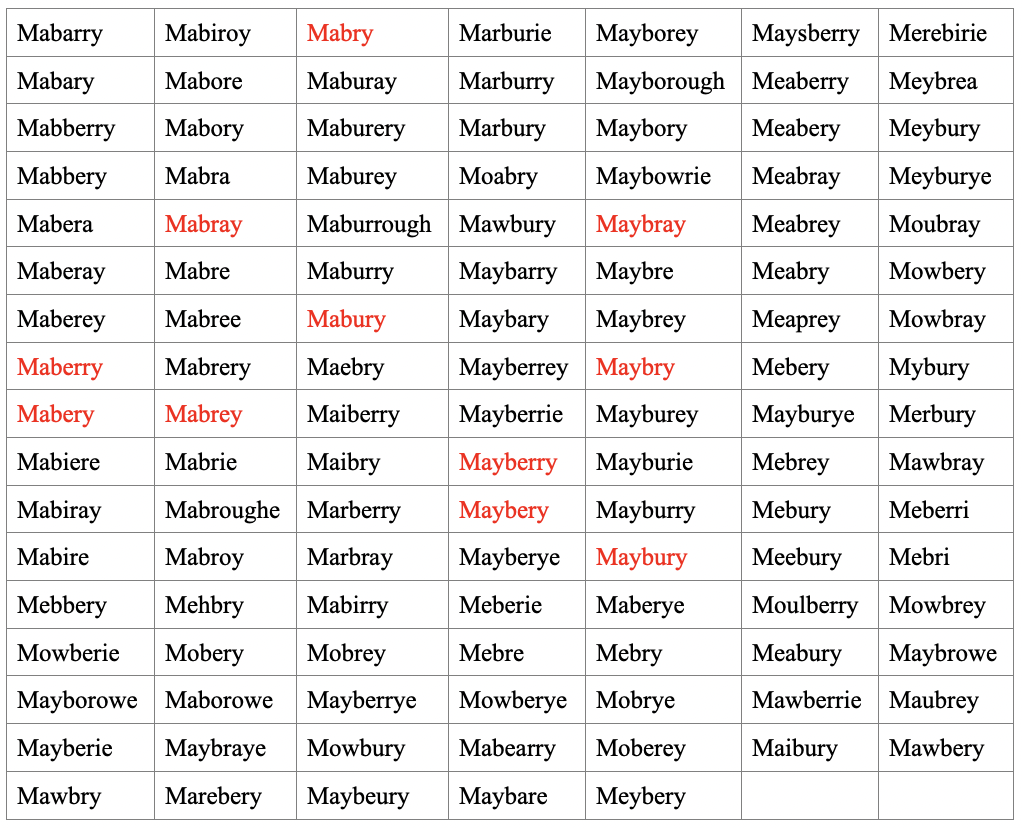
This is well illustrated by the records left behind by a SINGLE individual - our common ancestor, John Maybury of Sussex (ca 1540-1617).
When he married Margaret Bourder in Brightling, Sussex in 1565 his name was written as John Meberie.
When their daughter, Elizabeth was baptized in Etchingham in 1569 his name was given as John Mabery.
When his sons, John and Richard were baptized in 1570, his name was written as John Mayberie, and John Meabury respectively.
The parish register at Mayfield records him as John Mabry, when his daughter Mary was baptized in 1574.
The following year, when his son, Clement, was baptized, he was called John Mabery.
When his wife, Margaret, was buried at Mayfield in February 1576 he was John Maberye.
When he re-married a few months later it was still Maberye but his given name was written as Johathan.
When he failed to attend a frankpledge meeting at Hartfield in 1581, he was noted as John Maybury.
He was called John Maybery when his daughter, Elizabeth, was buried at Etchingham in 1593.
The record of the burial of his first son, John, at Bexhill uses the spelling Mayberie.
Just a month later at Burwash, when his daughter, Joan, was married, he was John Maybery.
Ten years later he was called John Maberye again, when his wife died at Ellastone in Staffordshire.
In a Monmouth court record in 1605 he was called John Mabery.
In July 1606, when his son William was baptized, he was John Mayberie.
When John Astell brought suit against him in Hampshire in 1609, the name was written as John Mayberrie.
And when he died at Cleobury Mortimer in Shropshire early in 1617 the burial record says John Maybery.
Thus, we have John Maybury's name spelled at least nine different ways in a period of fifty-three years. It should not surprise us that the name continues to be spelled in so many ways in our own time!
A Note to Family Historians
Those researching their family history often insist, for example, that:
"My family always spelled its name "MABERRY" as can be seen in two different census records and one deed".
"Our family always spelled the name MAYBERRY, I'm sure that is the correct spelling."
"I have never seen the name spelled other than "MABRY".
Family researchers should always beware of such statements. They are usually based on a few records. Additional research almost always turns up other records in which the name is spelled otherwise. Most statements like this are based on two or three generations. A look at the records of earlier or later generations will usually find exceptions. Records were not always written by immediate family members; others, including clergy, county clerks, judges, and even friends and neighbors may have supplied information, spelling the name the way it sounded to them.
As has already been explained, we have found more than 100 different spellings of our family in all kinds of records and documents over more than 500 years! Yet these variant spellings can almost certainly be traced to the same family. The moral of the story is that when you are looking for information about your family, be sure to look for different spellings. If you limit your search to a single spelling, you are likely to miss important records!
Don Collins
2014