The Early Mayberry and Maybury Families of Co. Kerry, Ireland
Michael A. Smithson
June 2026
The Maybury and Mayberry families of Kenmare and County Kerry, Ireland, have attracted attention from a variety of historians for well over a century. The role that the Maybury and Mayberry families played in post-Cromwellian land settlement and subsequent struggles for land ownership in the Kenmare region have been noted by local historians. Mayberrys and Mayburys are not uncommonly mentioned in the work of historians tracing the development of the English, Irish and American iron industries. Naturally enough, the largest group of researchers into these families have been family historians and genealogists. They have been the more focussed in their enquiries and, unfortunately, the more frustrated by the paucity of evidence for the relationships and activities of these families. This is especially the case for the period prior to the mid18th century where historians have had to rely on several 19th century pedigrees and a small number of documents, their contents often fragmentary. The work of all these historians would benefit from a reassessment of the evidence relating to the Maybury and Mayberry families prior to the mid18th century, especially in the light of new evidence from DNA testing.
Who were the Mayburys and Mayberrys?
The Maybury and Mayberry families of County Kerry are a branch of a wider Maybury family with its origin in England during the 16th and early 17th centuries. Throughout this period, a plethora of spellings were applied to the family surname. Maybury is now used as the standardized surname for the wider family while the spelling Mayberry was similarly used in 19th century Ireland. Whenever possible in this paper, the spelling of individuals’ surnames is that used by the individuals themselves or, failing that, used in the primary source that mentions them. The flexibility in spelling has been the cause of some confusion about the origin of the family. There is, for example, no evidence for the commonly-held claims that their origins lay in the Norman Invasion of England in 1066 or that the family are a branch of the Mowbray family. Y-DNA testing of Mowbray individuals has not established any significant genetic relationship.¹
The Maybury family who are the subject of this paper comprise around 70% of the 154 participants in the FamilyTreeDNA Maybury DNA Project, bearing variations of the Maybury surname.² They have undertaken Y-DNA testing for STRs (or Short Tandem Repeats) and have been found to be closely related. Conventional genealogical research into one family branch, the Mayberys of Wick, UK, and Australia, headed by John Maybury (1577-1651) of Cleobury Mortimer, Shropshire, has convincingly claimed that the common ancestor of these 70% of Mayburys was John Maybury, a hammerman of Sussex, England, who died in Cleobury Mortimer in 1617.
John Maybury’s occupation of hammerman is significant. Hammermen and finers were ironworkers and key craftsmen in the period beginning in the late 15th century which saw the introduction of Walloon or blast furnace technology into England. Ironworkers brought from the Continent drove the development of this technology in England and it may well be that John Maybury of Sussex’s father or grandfather was one of these migrant craftsmen. John would have learnt his trade within his circle of relatives because the ironworker workforce was dynastic in nature. Three of John’s four sons, whose careers are known, were also hammermen and the Maybury surname became synonymous with iron-working well into the 18th century. The iron workforce was also highly mobile, moving throughout England and Wales as the technology spread and as new resources were exploited; always seeking new work opportunities as communicated through the ironworking network. It is not surprising that, in 1671, the brother of ironworks investor Sir William Petty referred to his ironworkers as ‘the Iron Tribe’.³ The expansion of the English iron industry, and the Mayburys’ horizons, soon reached beyond Britain, to Ireland and thence to the American colonies.
As part of this expansion, three Mayberry hammermen, Thomas, Francis and John, were working in the ironworks at Enniscorthy in County Wexford, Ireland. They were enticed by Sir William Petty to shift to his Glanarought ironworks near Kenmare, Co. Kerry, in the early 1670s. They were characteristic of a ‘chafery’ team comprising a master hammerman, a ‘hammerman’s man’ and an apprentice, often related individuals.⁴ They joined a workforce of other hammermen and finers, some bearing old migrant ironworker surnames: Labinder (Lavender), Russell, Bardin, Haley (Helys), Pinyon and Turke.⁵ Undoubtedly, the Mayberrys made the acquaintance of a junior clerk, Richard Orpen, at Glanarought. By 1672, the Mayberrys and a large number of the ‘iron tribe’ abandoned Petty’s mismanaged ironworks and the Mayberrys returned to their base at Enniscorthy. Petty finally closed his Glanarought ironworks in c.1677. For his part, Richard Orpen rose to become an agent in Petty’s Glanarought colony and he began to revive the Glanarought ironworks during the 1680s. At some point, a Mayberry married Richard Orpen’s sister Rachel.
In the midst of Orpen’s ironworks revival, another Maybury – William Mabury – arrived in Glanarought in c.1686 and took up land at Dromoughty, Parish of Tuosist, and probably at Gortnadullagh near Kenmare. All seemed lost for both Mabury and Orpen during the Williamite War (1689-1691). In its chaotic aftermath, Orpen struggled to regain his agency at Glanarought, residing for a time with Francis Mayberry at Enniscorthy, and Mabury struggled to have his land restored. Both aims were achieved. In 1697, Orpen obtained a Grand Lease over the Petty Estate and sub-let large areas of the estate during 1697/8. Mabury became one of Orpen’s sub-tenants and served as a witness for several of Orpen’s sub-leases. By 1711, yet another Maybury, Richard Maybery, had established himself in Gortalinny, adjacent to William Mabury’s land at Gortnadullagh. By the 1760s, two Mayburys: Augustus Maybury of Gortascrehane (otherwise of Kilgortaree, Gortree [Gentree] or Dromaphihane, d.1785) and William Maybury of Cledagh (Cleady, d.1794-5), and a Mayberry, John Mayberry of Greenlane (d.1792), were established as heads of three families at Kenmare.
This simple account belies the complexities and controversies that surround the activities and relationships of the Mayburys in Kerry from the mid-17th century to the mid-18th century.
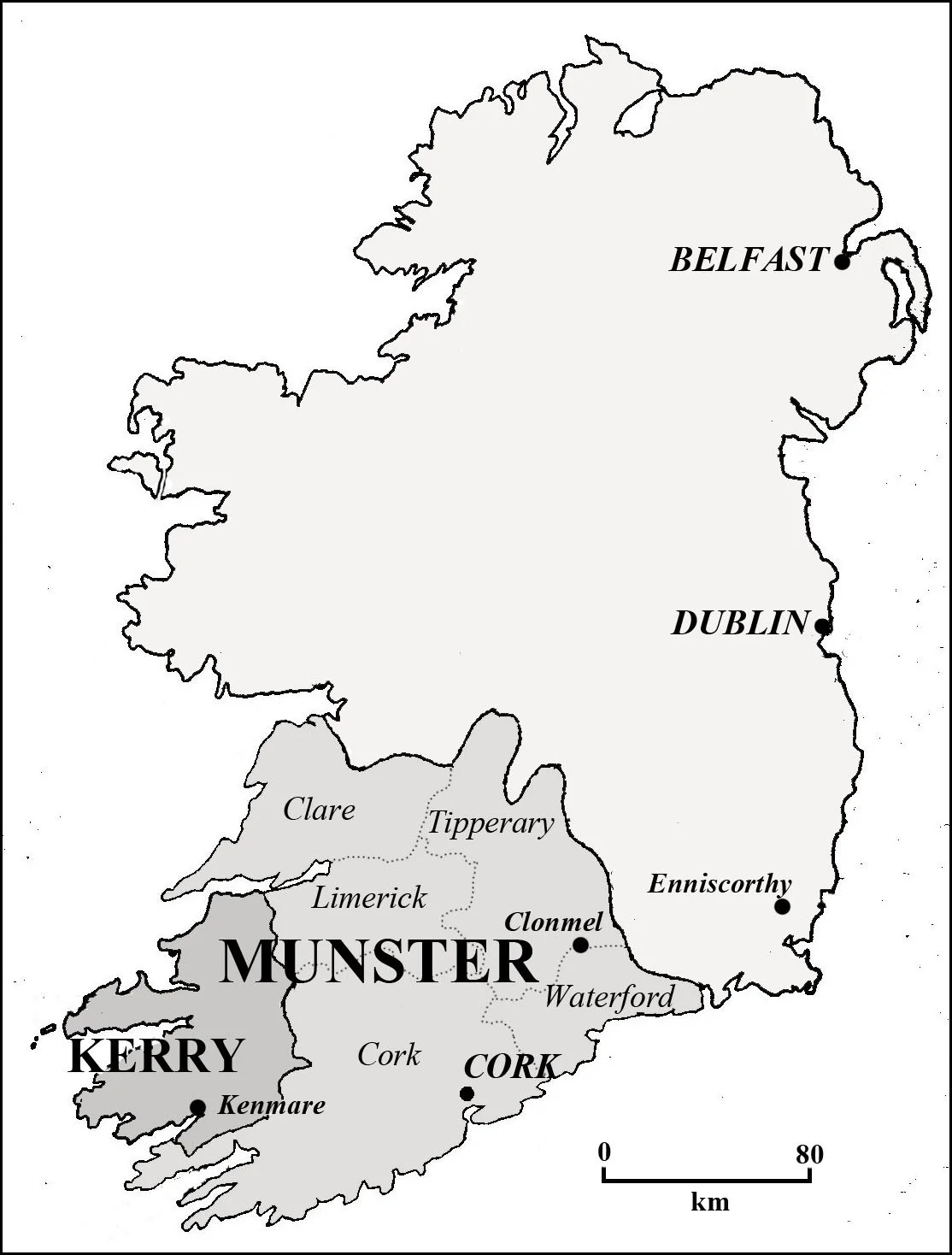
Ireland, showing County Kerry within the province of Munster.
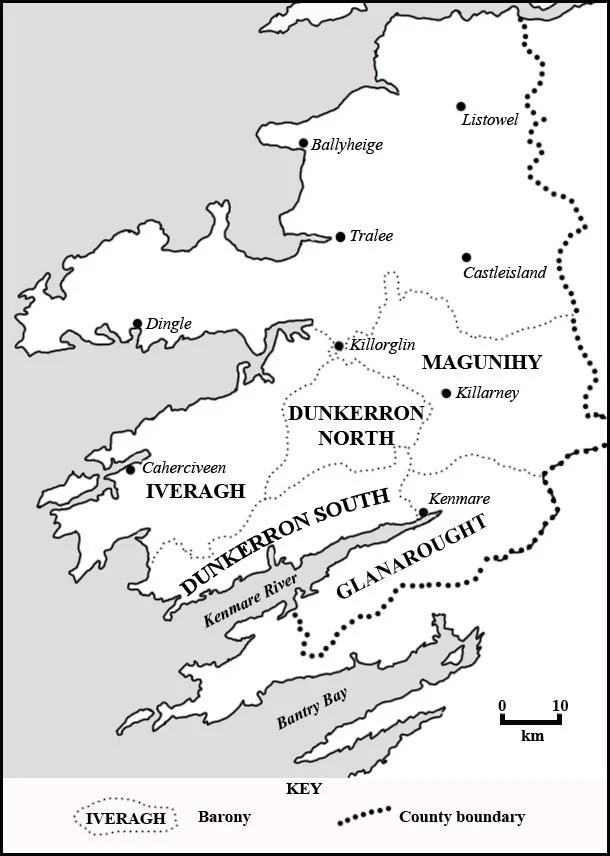
Kenmare and other principal towns of the baronies of Dunkerron, Glanarought, Iveragh and Magunihy of County Kerry.
Tracing the Mayburys Through Time
Recording the story of the Mayberrys and Mayburys of County Kerry may have begun in 1745, less than a century after they arrived, when Raymond Orpen (d.1764) compiled a pedigree of the Orpen family of the Barony of Glanarought, Co. Kerry. Raymond was the son of Richard Orpen of Ardtully (d.c.1741) and grandson of Isabella Palmer and Richard Orpen of Glanarought, the Petty agent who had established the Orpens as the dominant settler family in the vicinity of the future town of Kenmare in the late 17th century. Raymond was known as ‘an indefatigable genealogist’ and his pedigree was bound into a volume known as ‘The Red Book’ held by Raymond’s brother, Richard Orpen (d.1810) of Ardtully.⁶
The reason why Mayberry genealogy was of interest to Orpen family genealogists well into the 20th century was due to the marriage of Rachel Orpen, the sister of Richard Orpen of Glanarought, to a Mayberry at some point in the latter half of the 17th century. During the 19th century, a new generation of Orpen genealogists drew upon Raymond’s research. Emanuel Hutchinson Orpen (1782-1863), attorney-at-law, viewed the ‘Red Book’ before it was lost. Luckily, his contemporary, the solicitor Richard John Theodore Orpen (1788-1876) - later Sir Richard - was able to make use of some extracts from the ‘Red Book’ preserved by Richard of Ardtully’s son, Richard Orpen Townsend (1771-1848).⁷ Richard J. T. Orpen also received a good deal of assistance in his research from E. H. Orpen.⁸
The 18th and 19th century genealogists relied to a large extent on documents in the possession of their families, their own recollections and the memories of Orpen informants. E. H. Orpen, for instance, obtained information
from his aunt Margaret Lucy, from Richard Orpen of Ardtully, and from memoranda in the said Richard Orpen's possession written by a greatuncle, Raymond Orpen, and from several other members of the family.⁹
Another genealogist known to the Orpen family, the Rev. Abraham Henry Herbert Palmer, drew upon ‘old family documents, etc., in possession of Edward Orpen Palmer, Killowen, Kenmare, Co. Kerry’, in his ‘Genealogy of the Family of Palmer, of Kenmare Co. Kerry, Ireland’ published in 1874.¹⁰
It is almost certainly due to Richard J. T. Orpen that an Orpen pedigree was first published, appearing as ‘Orpen, of Glanerough’ in Volume IV of John Burke’s, Commoners of Great Britain and Ireland in 1838.¹¹ Its initial reference to the Mayberrys was brief:
Rachel, m. – Mayberry, ‘esq. and had a son, Richard Mayberry, who m. a sister of William Duckett, and had issue.¹²
There were a number of ‘Alterations and Additions’ prefacing Burke’s main collection of pedigrees. Among these was a detailed pedigree of the Mayberry family of Kenmare. It is very similar to a Mayberry pedigree preserved in an 1874 copy of an Orpen genealogy compiled by Emanuel Hutchinson Orpen, confirming the early collaboration between the two Orpen genealogists. However, there were significant differences.
Examining E. H. Orpen’s version of the Mayberry pedigree, it seems clear that the Orpens had access to two pedigrees on which to base their Mayberry genealogy. One appears to have been the work of the Orpens’ fellow attorney, William Duckett of Mount Street, Dublin. As a grandson of Augustus Maybury of Kilgortaree by his eldest daughter Mary, Duckett headed his Mayberry pedigree with Augustus and it understandably gave detailed attention to William and Mary Duckett’s immediate family - detail that Richard J. T. Orpen omitted from his 1838 writings. The second pedigree appears to have come from the Mayberry family of Greenlane, Kenmare, and it comprises the major part of the Mayberry pedigree that appeared in the ‘Alterations and Additions’ section of Commoners. Unlike William Duckett’s pedigree, it reached further back in time and was headed by a John Mayberry. Richard J. T. Orpen would have faced no difficulties obtaining Mayberry recollections at Kenmare. By 1838, the Mayberrys and the Orpens had lived together in Kenmare for about 150 years. The Mayberrys were one of the largest middleman landlords on Trinity College Dublin’s Gortagass Estate at Kenmare and Richard J. T. Orpen was their head landlord and very well-acquainted with members of the family.
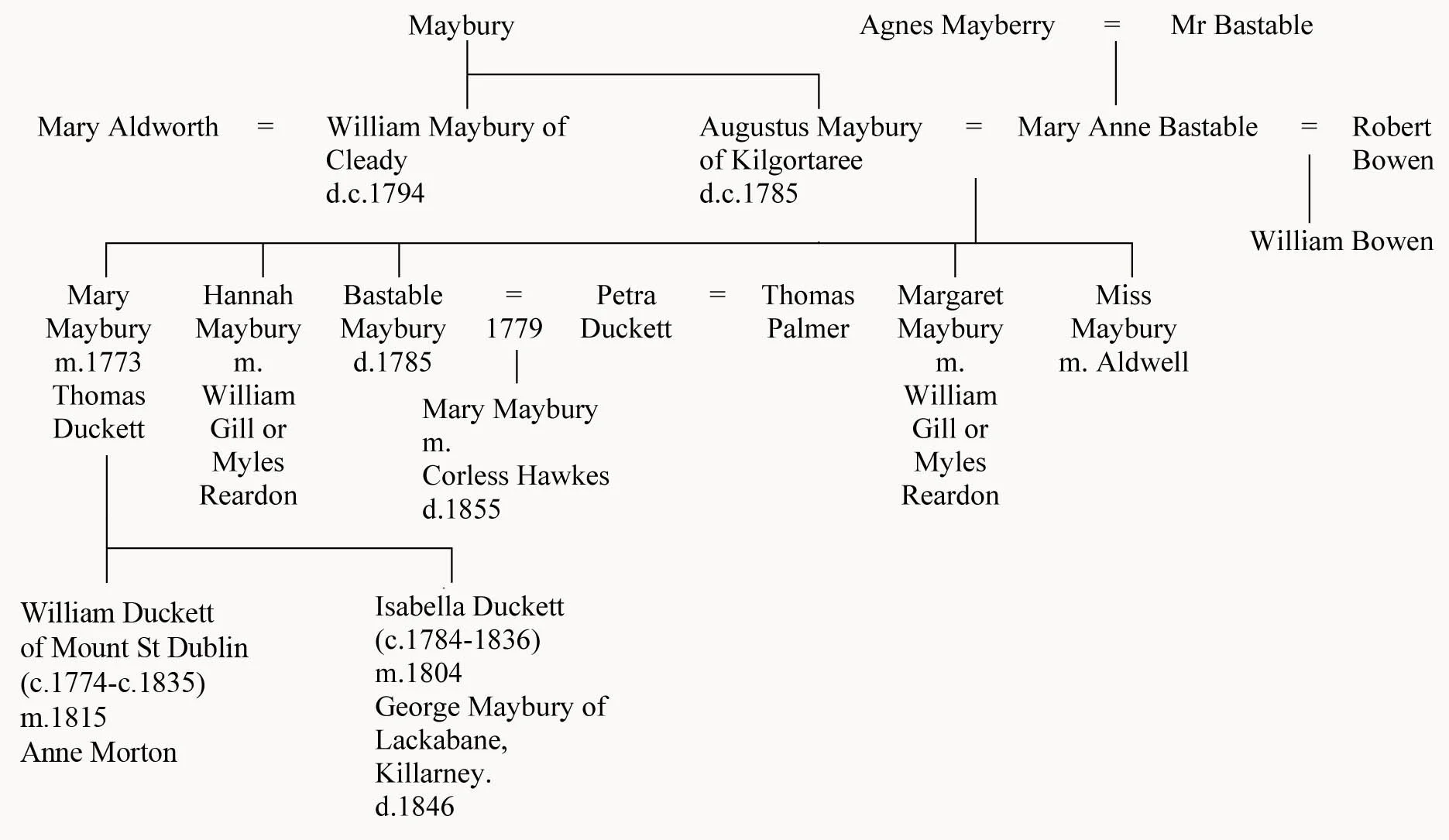
Simplified family tree of Augustus Maybury of Kilgortaree. The relationship of Agnes Mayberry, who married a Mr Bastable, to other Mayburys has not been established. Only two of Mary and Thomas Duckett’s nine children are shown.
In his 1838 Mayberry addition, Richard J. T. Orpen had decided to concentrate on only one of the two pedigrees – the Greenlane Mayberry pedigree, which he considered to be the senior male line. The Mayberry-Duckett pedigree was linked to the Mayberry pedigree as a junior or cadet line, with Augustus Maybury of Kilgortaree placed alongside John Mayberry of Greenlane as a son of Richard Maybery and reduced to a bare mention. The result was a vaguely-worded opening paragraph:
Rachel Orpen, who m. John Mayberry, esq. had a son, Richard Mayberry, who m. as already stated, a sister of William Duckett, esq. and had, with a son, Bastable, and another son, who m. and had a son, Augustus
that introduced the main Greenlane Mayberry pedigree beginning with: ‘John Mayberry, who m. Miss Eliza Elmsey … ¹⁴ There was no mention of a third important head of a branch of the Mayburys at Kenmare, William Maybury of Cleady. Obviously, no pedigree had been received or sought from the Cleady Mayburys and the Orpen genealogists were not inclined to follow up what to them was a minor branch of their Orpen family.
What was clear from the 1838 Commoners Mayberry pedigree is that the Mayberrys regarded John Mayberry who married Rachel Orpen as the head of their family. This was not so clear to Orpen researchers in the years that followed. In the 1874 copy of Emanuel Hutchinson Orpen’s Mayberry pedigree, John Mayberry was replaced by William Mayberry as Rachel’s husband.¹⁵ In that same year, the Rev. Abraham Henry Herbert Palmer published the same claim in his ‘Genealogy of the Family of Palmer, of Kenmare Co. Kerry, Ireland’.¹⁶ Rev. Palmer’s prominent Kenmare family had continuing family connections with the Orpens from the day when Richard Orpen of Glanarought had married Isabell Palmer; indeed, Rev. Palmer was a familiar face to E. H. Orpen’s grandnephew, the noted Irish historian Goddard Henry Orpen, and had adopted the surname Orpen-Palmer in 1892.¹⁷ In 1930, Goddard Henry Orpen published his book, The Orpen Family.¹⁸ He also rejected John Mayberry as Rachel Orpen’s husband in favour of William Mayberry or Mabury.
No doubt the reason for this revision was because John Mayberry was invisible in the sources used by Palmer and the Orpens, while the name William Mabury dominated. In the 1920s, Goddard Henry Orpen had been able to draw upon the work of Sir Richard John Theodore Orpen and of Emanuel Hutchinson Orpen, bringing a critical eye to their efforts, correcting and rejecting where necessary. He also had access to his family’s documents. However, he had cast his net far more widely for evidence than his predecessors, as one would expect of one of Ireland’s leading historians. He conducted research among the Petty, Shelburne and Lansdowne records held by Henry William Edmund Petty-Fitzmaurice, the 6th Marquis of Lansdowne, dating back to the beginnings of Sir William Petty’s plantation at Glanarought.¹⁹ G. H. Orpen obviously agreed with his fellow Orpen and Palmer genealogists in judging that property and legal records, primarily from the 1690s into the early 18th century, that bore the name ‘William Mabury’ provided a more reliable indication of the name of Rachel’s spouse. It must have been concluded that the name John Mayberry, which did not appear in these documents, was a mistake on the part of the Mayberry informants.
The irony is that, as a consequence of the conviction among genealogists that he was a mistake in a pedigree, John Mayberry was erased for many casual readers from the single historical record in which he did appear – one that seems to have been overlooked by Goddard Henry Orpen. Orpen’s communications with the Marquis of Lansdowne, which probably included his views on the Mayberry-Rachel Orpen marriage, appear to have given the Marquis an unfortunate impression. In 1937, Lansdowne published his history, Glanerought and the Petty-Fitzmaurices, and drew attention to a list of ironworkers, who had abandoned Sir William Petty’s Glanarought ironworks in c.1672, found amongst Sir William Petty’s papers drawn up soon after. Lansdowne claimed that
among the [hammermen] there were two men of the name of Mayberry, one of whom, William, afterwards married [Richard] Orpen's sister and became the ancestor of the numerous Mayberrys now living in the neighbourhood of Kenmare.²⁰
despite the list actually containing the names of three, not two, Mayberry hammermen: Thomas, Francis and John, with no mention of a William. Nevertheless, Lansdowne’s claim helped to entrench the belief among researchers that William Mayberry (Mabury) was the progenitor of the Mayburys of Kenmare.²¹
It seems that very few Maybury family researchers around 2010 were familiar with Emanuel Hutchinson Orpen’s genealogy. It had been bound into a volume that ultimately found its way into the hands of his great-grandnephew, John Herbert Orpen (1868-1950), dean of Bury St Edmunds, England. To date, that volume has not been located. A handwritten copy had been made with additions by John H. Glascott in 1874 with the title, ‘A Pedigree and Genealogical History of the Family of Orpen of the County of Kerry’ and this was passed down to E. H. Orpen’s grandnephew, Goddard Henry Orpen. It was only recently viewed by the author, courtesy of the Monksgrange archives, Co. Wexford.
Instead, Maybury researchers depended greatly on John Burke’s, Commoners of Great Britain and Ireland of 1838, but they struggled to interpret the vaguely-worded opening paragraph of the Mayberry pedigree. Thankfully, they had additional sources of information. One was the only known 19th century Maybury (rather than Mayberry) pedigree. It was compiled by Richard Hawkes Maybury, a descendant of William Maybury of Cleady.²² Richard was a young 19-year-old emigrant who compiled a family pedigree in 1865, a little fragment of his heritage to carry with him to the United States. In this document that still remains in the possession of his descendants, he noted that ‘William Maybury had two brothers - the Greenlane family sprung from one and the Gentree family from another’. These were the three men: Augustus Maybury of Kilgortaree (Gortree or Gentree), William Maybury of Cleady and John Mayberry of Greenlane, who had acted together with a ‘Francis Maybury, Gent., administrator of William Maybury, Gent., deceased’ when William Petty-Fitzmaurice, Lord Shelburne, negotiated with his tenants over the tenure of land in Glanarought during the mid18th century. These dealings had been examined by Gerard J. Lyne in a series of three journal articles published in the 1970s.²³
Armed with this background knowledge, it was concluded that the 1838 Mayberry pedigree read: Richard Mayberry had three sons: Bastable; an unknown son who had a son Augustus; and John. In this, it was believed that the compiler of the 1838 pedigree had unfortunately confused Augustus Maybury with his son Bastable Maybury, while not naming William Maybury of Cleady, whose eldest son was indeed Augustus. In fact, this interpretation was wrong. The original contention outlined in E. H. Orpen’s genealogy had actually been that Richard Mayberry had two sons: Augustus and John - Augustus had two sons, Bastable and William Mayberry (who had a son Augustus).
As it transpired, the family historians’ misinterpretation did not matter in the long run because E. H. Orpen was himself mistaken and the family historians had ended up closer to the mark by 2014. In placing William Maybury of Cleady, whose son was Augustus, as Augustus Mayberry’s son, E. H. Orpen confused him with William Bowen, Augustus’ stepson and the son of Mary (Bastable) Bowen, brought from her previous marriage to Robert Bowen. What E. H. Orpen also did not realise was that William Maybury of Cleady was Augustus’ brother, not his son. The proof of this relationship had been recorded in a memorial submitted to Henry Pelham, Lord Lansdowne’s agent, in 1796 by Corless Hawkes, husband of Augustus’ granddaughter Mary, one of several memorials and affidavits arising from a dispute over the execution of the will of Bastable Maybury, Augustus’ only son.²⁴
By 2014, few doubts were entertained over the claim that Rachel Orpen’s husband had been William Mabury rather than John Mayberry. Opinion among Maybury family researchers had settled upon the following (shortened) pedigree:
1. William Mabury, m. Rachel Orpen
2. Richard Maybery, m. William Duckett’s sister, Miss Duckett
3. Augustus Maybury of Gortascrehane or Kilgortaree, m. Mary Anne (Bastable) Bowen
4. Bastable Maybury, m. Petra Duckett
3. William Maybury of Cleady, m. Mary Aldworth
4. Augustus Maybury
3. John Mayberry of Greenlane, m. Eliza Elmsey
Yet, some problems remained. There were other clusters of Mayburys in Kerry to contend with. Family historians struggled to insert the Mayburys of Cloghereen (also of Lackabane and Lakeview), Killarney, into the broader Kenmare Maybury pedigree. Emanuel Hutchinson Orpen had also unsuccessfully attempted the task, incorrectly placing George Maybury of Lackabane (d. 1846), son of William Maybury of Cloghereen (d.1803), as the son of his elder brother Abraham Maybury (d.1829) and Eliza Mayberry, daughter of John Mayberry of Greenlane.²⁵ The Mayburys of Muckross, Killarney, and the Mayburys of Gortnadullagh and Gearhanagoul, Kenmare, presented a similar challenge.
By 2022, however, new DNA evidence had emerged that prompted a re-examination of the historical evidence. This challenged the view that William Mabury was the husband of Rachel Orpen and the progenitor of the Maybury and Mayberry families - a single lineage at Kenmare. Instead, it was suggested that two lineages were established in Kenmare by the beginning of the 18th century: the Maybury family, headed by William Mabury; and the Mayberry family headed by John Mayberry (who married Rachel Orpen) and his son Richard Maybery. Both lineages appeared to descend from a common early 17th century ancestor.
The Challenge of DNA
The use of DNA to investigate the origins and relationships of the Maybury family began in 2003 when Don Collins in the United States initiated the Maybury DNA project in an effort to trace his Mabry family’s origins in England. Y-DNA testing for STR (or Short Tandem Repeats) in male Maybury descendants with the testing company FamilyTreeDNA (FTDNA) revealed several families of genetically related people bearing variants of the Maybury surname. As has already been outlined, this cluster comprised about 70% of all Maybury-surnamed participants in the Maybury DNA Project and included the Kerry Mayburys and Mayberrys. It was also concluded that the common ancestor of all these Mayburys was John Maybury, a hammerman of Sussex, England, who died in Cleobury Mortimer in 1617.
STR testing, often testing only 12 to 37 markers on the Ychromosome, seemed not to easily differentiate the various branches of the wider Maybury family and, by 2016, a Next Generation Sequencing (NGS) test, marketed by FTDNA as BigY, began to be used to identify SNPs (Single Nuclear Polymorphisms) in Maybury DNA Project participants. As the first test results for Kenmare Mayberrys and Mayburys came in, it appeared that the assumed close relationship between the two families was questionable. This led to a critical reappraisal of the documentary evidence, including the 19th century pedigrees, relating to the Kenmare and other Kerry families. Following that reappraisal, and although subsequent test results did show that the Kenmare families were indeed closely related and very likely to have shared a common 17th century ancestor, it could no longer be assumed that the Kenmare Mayburys and Mayberrys were both descendants of William Mabury.
By 2021, BigY tests had proved their worth, providing a basic Maybury family tree. They revealed that all the 70% of male Maybury DNA Project participants found to be related by STR testing almost certainly carried the genetic variation, the SNP R-BY13824. Downstream of R-BY13824 were three main family branches: R-FTA43422, R-FT379334 and R-FTA84209. As has already been explained, genealogical research had already indicated that one Maybury family, the Mayberys of Wick (UK) and Australia, could claim the hammerman John Maybury of Sussex (c.1540-1617) as their ancestor, through his son John Maybury (1577-1651) of Cleobury Mortimer. The Mayberys were shown to belong to the R-FTA84209 family branch. John of Cleobury Mortimer was one of three sons of John Maybury of Sussex known to have had sons. The other sons were Nicholas Maybury (c.1567-1634), and Clement Maybury (b.1575). Nicholas is considered to be the progenitor of the R-FT379334 family branch, well-represented in Northern Ireland. Clement Maybury is considered to be the progenitor of the R-FTA43422 family branch that included the Kerry Mayburys and the American Mabry family headed by Francis Maybury (d.1712) of Surry County, Virginia.
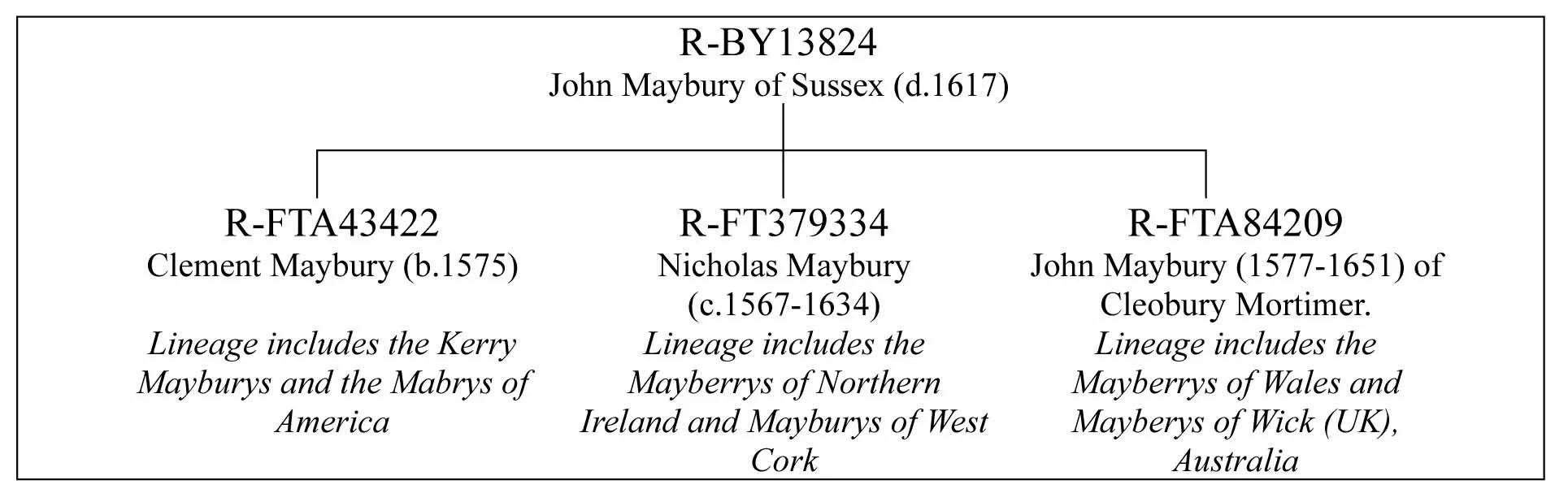
Three main branches of the family lineage of John Maybury of Sussex (d.1617) revealed by Y-DNA SNP testing after 2016.
BigY tests were undertaken by descendants of two of three Kenmare Maybury family lineages, the heads of whom had been well-documented from the 1760s: William Maybury of Cleady and John Mayberry of Greenlane. The third Kenmare Maybury lineage of the 1760s, headed by Augustus Maybury of Kilgortaree, had been extinct in the male line since 1785. Descendants of three other Kerry Maybury families were tested: the Mayburys of Muckross, Killarney, whose head was believed to have been a son of William Maybury of Cleady; the Mayburys of Gearhanagoul, Kenmare; and the Mayburys of Cloghereen, Killarney. The Mayburys of Cloghereen had been party to the property affairs of William and Augustus Maybury and John Mayberry in the 1760-70s and most likely descendants of Francis Mayberry, one of the hammerman who had worked in Glanarought in the 1670s, a connection that will be discussed in detail below.
All these Kerry Maybury descendants carried the SNP R-FTA43422 but, surprisingly in contrast to the R-FTA43422 descendants of Francis Maybury (d.1712) of Surry County, Virginia, it appears that further downstream branching did not occur until the late 18th century. Unfortunately, this meant that even SNP testing could not precisely differentiate the various branches of the Maybury family in Kerry. It could not, for example, determine when the Kenmare Maybury and Mayberry families had diverged and who could be claimed as their ancestor – or, to view matters from another perspective, who had married Rachel Orpen. Nevertheless, the DNA testing had provided valuable new evidence that, combined with the limited historical evidence available, was able to provide plausible answers to these questions.
John Mayberry, William Mabury and Rachel Orpen
A key controversy in Kenmare Maybury historical and genealogical enquiry has centred on the identity of the Maybury who married Rachel Orpen in the mid17th century, was he William Mabury [d.c. 1720], as generally accepted, or a John Mayberry whose presence in Glanarought in the early 1670s was seemingly overlooked by some. Crucially, the evidence that favours John Mayberry as Rachel’s spouse, the 1672 list of workmen at Glanarought, places John as the right person, in the right place, at the right time.
John was recorded in Glanarought in a list of ironworkers who had abandoned Sir William Petty’s ironworks in c.1672.²⁶ It is important to note that he was one of three Mayberry hammermen on the list. As has already been explained, this was characteristic of a chafery team of related individuals: master hammerman, ‘hammerman’s man’ and apprentice. It is also significant that Thomas Mayberry headed the list, not only of the chafery team and the hammermen, but of all the ironworkers. The correspondence of the period makes it plain that the loss of one Mayberry ironworker, most likely Thomas although he is not named, was keenly felt by Petty and his agent, John Rutter. Sir William commented in a letter dated 17 December 1672 that Maybury was once again at Enniscorthy and the Wexford ironworks would profit as a result.²⁷ He was echoed by Rutter who wrote, in a letter dated 28 December, that Maybury and the others had returned from whence they came, and pondered on the value of superior workmen.²⁸
Despite their short stay, the Mayberry hammermen must have made the acquaintance of a young Richard Orpen, who had been employed at Glanarought by Petty in a junior role from the late 1660s.²⁹ There was ample opportunity for Orpen’s sister Rachel to marry John Mayberry: the third Mayberry on the 1672 list, probably the apprentice hammerman and single. Indeed, Goddard H. Orpen reached the conclusion that Rachel was married by 1675.³⁰ John would have been judged a suitable match for Rachel by her brother. Richard Orpen was an enthusiastic assistant agent. He was also ambitious and had a talent for negotiating useful marriages. One sister, Dorcas, married Thomas Crumpe, the Port-Surveyor at Kenmare and Richard’s own marriage to Isabel Palmer forged an important alliance with the colony’s Anglican minister and influential settler. A marriage to the hammerman John Mayberry, son of a master ironworker, would also have had advantages. These advantages were not realised immediately – Petty closed his ironworks in around 1677. However, by the 1680s, Richard Orpen had proved himself a capable head agent in Kerry and had revived the ironworks that held ‘a stock of bar and sow iron worth £1500 sterling’ by 1689.³¹ It is not until this period that William Mabury is known in connection with Glanarought and his late arrival at Glanarought does count against a marriage to Rachel Orpen.³²
More is known about William Mabury than the hammerman John Mayberry, but what is known is still too little and too vague. William first appears in records relating to Glanarought when Thomas Dance wrote to Richard Orpen, on 25 May 1686, requesting that he forward the remainder of ‘Mabury’s bond’.³³ This accords with Mabury’s statement in an affidavit sworn by him on 1 January 1692/3 that the ‘farme of Drumoghty … was sett to him and his partners before [the Williamite War of 1689-91]’.
It is important to understand the historical context in which the affidavit was sworn. The Williamite War, waged in Ireland as a consequence of England’s ‘Glorious Revolution’ of 1688, saw Sir William Petty’s settlers expelled from Glanarought by Irish Jacobite forces, supporters of the deposed King James II. Before the war ended with the Irish surrender of Limerick in October 1691 to the forces of the new King William III, Orpen had assured Mabury that his land at Dromoughty would be restored. It proved an empty assurance when Orpen returned to Kerry only to find that a Captain Robert Topham had manoeuvred him out of the Glanarought agency. Mabury ‘found his farme sett unto one Teig Sulivane, nephew to one of the old proprietors deceased’ and Topham went to some lengths to ensure Mabury would not return to Glanarought. Orpen launched a campaign against Topham and appealed to Sir William Petty’s widow, Elizabeth Waller, Baroness Shelburne, for the dismissal of Topham and return of the agency. For his part, Mabury dispatched an affidavit to Lady Shelburne in an effort to reclaim Dromoughty. Both Orpen and Mabury’s campaigns had met with success by 1694.
In his affidavit, William Mabury also outlined how he came to Kerry: ‘he was brought at first out of England [to Glannerought] by Sir William Petty’. On the face of this account, Mabury appears to have been brought to Kerry from England as a settler. There is no mention of ironworking. After all, William Mabury was not among the eight Petty colonist families held back as prisoners by Irish forces to work Orpen’s ironworks in March 1688/9 after Orpen and their fellow colonists were expelled from Glanarought. There is no connection made to the three Mayberry hammermen who had been brought from Enniscorthy to work in Glanarought fourteen years before Mabury’s arrival, apart from all four being brought by Petty. Yet, perhaps too much emphasis should be placed on this single sentence.
One can certainly dismiss the idea that William Mabury was a random individual bearing the surname Maybury enticed to Glanarought. If it is accepted that William’s descendants made up at least one family of Mayburys who lived at Kenmare from the 1760s, William belonged to the branch of the Maybury family who carried the SNP R-FTA43422. This genetic variation appears to have emerged with the hammerman Clement Maybury (b.1575), tenth child of the hammerman John Maybury of Sussex. Clement Maybury worked as a hammerman in forges extending from Staffordshire to the Forest of Dean, near the Welsh border. It is almost certain that William was Clement’s grandson.
One of Clement’s sons, Thomas Maybury who was baptised 22 July 1621 at Wednesbury in Staffordshire, would have to be the prime suspect for Thomas Mayberry, hammerman in Glanarought c.1672 and father of John and Francis Mayberry. It is conceivable that Thomas worked the same territory as his father and this led to his relocation to Enniscorthy, Co. Wexford, Ireland. The ironworks at Enniscorthy was one of a number of ironworks, including Petty’s Glanarought ironworks, that were established by English entrepreneurs seeking to obtain profit from the Cromwellian Irish land confiscations of the 1650s. T. C. Barnard, in his study of Anglo-Irish ironworks at Enniscorthy, has noted a close economic relationship between Enniscorthy and the Forest of Dean and its adjoining areas of South Wales and Bristol, that stimulated the movement of tradesmen.³⁴ The probability that Thomas was one of these tradesmen is given some credence by James Maybury (c.1799-1870) of Muckross, Killarney, who claimed that he ‘was a descendant of the Maybury family of England, from whence his early ancestors settled in Wales’.³⁵It was Sir William Petty’s pressing need for skilled ironworkers that drew Thomas and his two sons, Francis and John, further into Ireland, to Glanarought in the early 1670s.
It is most likely, based on DNA evidence that will be explained later, that another of Clement’s sons, either Edward (1609-1665) or an unrecorded brother, was the father of a second Francis Maybury who established a parallel R-FTA43422 Maybury (Mabry) branch in the colony of Virginia, North America, also around the 1670s. Francis Maybury of Virginia died in 1712 and the last known documentary reference to the hammerman Francis Mayberry of Enniscorthy is dated 1706. William Mabury, who died c.1720, belonged to that same generation. William Mabury was, therefore, either a cousin to the hammermen Francis and John Mayberry or, given his proximity to their location and interests, most probably their brother.
William Mabury does not appear on the 1672 list of ironworkers who subsequently abandoned Petty’s works, the most important document for understanding mid17th century Maybury relationships in Kerry. That is not really surprising. Not relevant and, therefore, not recorded on this list were the families of the workers who departed Glanarought in c.1672 and that could have included a younger son or brother, William Mabury. Some workers at Glanarought would have been single, but many would have been married. References to ironworkers’ families are rare. In one of these rare instances, Thomas Waller, Petty’s brother-in-law, notified Sir William of the arrival at Glanarought of works manager Thomas Heald and workmen, with women and children among the party, in 1671.³⁶ It is possible that the three Mayberry hammermen were among this party. Whatever the case, it is almost certain that Thomas Mayberry and possibly Francis Mayberry were accompanied by wives and children. John Mayberry, the apprentice hammerman, was probably single. He was a likely match for Rachel Orpen, while younger brother William Mabury was not. Indeed, one could suggest a reasonable time line for the life of young William. He had to have been at least 21 years old in 1686 to have signed the contract for the Drumoughty lease. If, for example, William was in his twenties in 1686, he could easily have been under the age of ten while at Glanarought in 1672; in his 40s when his suspected sons Augustus and William Maybury were born at Kenmare in around 1710; and in his 50s when he died around 1720.
Despite there being no indication in William Mabury’s affidavit of 1692/3 of any connection between him and the three Mayberry hammermen of 1672, at least one Mayberry - the hammerman Francis - continued to be involved with Glanarought, his activities serving as a backdrop to William Mabury’s own involvement there. ‘Francis Mawberry’ was mentioned in the 1677 will of Thomas Crookshank, Petty’s agent at Kenmare, that was settled by Sir William in 1685, incidentally around the time of William Mabury’s arrival in Glanarought.³⁷ In 1693, when both Richard Orpen and William Mabury were locked in dispute with Petty’s agent Topham, it was recorded that a letter to Richard Orpen was redirected to the residence of ‘Francis Mabery’ at Enniscorthy.³⁸ A brief entry in the Exchequer Bill Books records a case brought by Walter Butler in 21 June 1706 against ‘Richard Mabery, ffrancis Mabery senr., and ffrancis Mabrey junr.’ and others.³⁹ By 1711, Richard Maybery is known to have resided at Gortalinny, neighbouring William Mabury’s townland of Gortnadullagh, parish of Kenmare (his relationships will be examined later). This final reference to Francis located so far may indicate that he died soon afterwards, although his financial involvement in Maybury affairs was felt well into the 18th century. The reason why that was the case is apparent in William’s affidavit of 1692/3, that ‘the ‘farme of Drumoghty … was sett to him and his partners’. It will be argued that these partners were probably the hammermen Francis and John Mayberry, William’s older brothers.
To return to William’s other statement made in his affidavit of 1692/3, that ‘he was brought at first out of England [to Glannerought] by Sir William Petty’, there are two reasons why this should not be taken at face value. Firstly, if William was Thomas Mayberry’s young son in 1672, he may not have been fully aware of the details of his father’s affairs other than his family originally came from England and were brought to Kerry by Petty. Secondly, and more probably, William was simplifying his and his family’s story for Lady Shelburne, emphasising his claim to land at Dromoughty with reference to his Englishness and relationship to Petty, while glossing over their stay in Enniscorthy and their short residence at Glanarought. That simplification may not have been entirely William’s doing. William’s penmanship, as exhibited on documents he signed, suggest that it is unlikely that it was he who composed his affidavit of 1692/3. It would be usual practice for William to have employed an amanuensis to compose his affidavit and any nuances or subtleties employed may have been advised by him and then agreed to by William.
Goddard H Orpen, for one, seems to have read more into Mabury’s affidavit than was warranted. He knew that a Mayberry had married Rachel Orpen; that William Mabury’s name predominated in late 17th and early 18th century property records; and, finally, that Richard Orpen’s brother-in-law Thomas Crumpe, had also submitted an affidavit criticising Captain Robert Topham during the struggle with Topham for the Petty agency at Glanarought. It is understandable that he would assume that William Mabury was also Richard Orpen’s brother-in-law. Yet no contemporary document actually states that William Mabury was Orpen’s brother-in-law – nothing akin to Richard Orpen’s letter to Thomas Crumpe in 1692, in which he refers to himself as ‘yr. affectionate Brother’.⁴⁰ It is just as likely that William was just one of the several other persons who also swore affidavits against Topham. Although William’s attack on Topham would serve Orpen’s cause, the main objective of his affidavit was the restoration of Dromoughty.⁴¹ Instead, William Mabury may credibly be identified as the brother of Richard Orpen’s brother-in-law - the hammerman John Mayberry who married Rachel Orpen, the ancestor recognised by the Mayberry family of Greenlane, Kenmare, in the early 19th century.
Fathers, Sons and Property.
Setting aside for now the question of who, William Mabury or John Mayberry, was Rachel Orpen’s spouse, 19th century Orpen genealogists considered Richard Maybery of Gortalinny to be Rachel’s son and the father of Augustus Maybury of Gortascrehane (otherwise of Kilgortaree, Gortree or Gentree) and John Mayberry of Greenlane. In his 1865 pedigree, Richard Hawkes Maybury added his ancestor William Maybury of Cleady (d.1794-5) as a third sibling, noting that ‘William Maybury had two brothers - the Greenlane family sprung from one and the Gentree family from another’, thus assembling the heads of the three main Maybury family branches at Kenmare. However, his pedigree made no mention of Richard Maybery or his father.⁴² A re-examination of Maybury property records has challenged these 19th century pedigrees.
A lease enacted between Richard Orpen and William Duckett, dated 12 May 1711, is the first document clearly placing Richard Maybery at Kenmare.⁴³ It mentions Richard as holding land (a field) and William Mabury holding woods, forage land and a garden in the townland of Gortalinny – Richard was termed ‘Richard Maybury of Gurtalinny’ in 1716.⁴⁴ William Mabury’s residence was located in the townland of Gortnadullagh, adjoining Gortalinny. Richard would go on to marry William Duckett’s sister, Mary. By this time, seventeen years after the reinstatement of Orpen as agent, there had been many changes at Glanarought.
In April 1696, Sir William Petty’s son Henry Petty succeeded his older brother, Charles Petty, 1st Baron Shelburne, who had died without issue. Henry was still a minor and had inherited an extensive but unruly estate in Kerry. In November 1696, Henry Petty gave his uncle, James Waller, power of attorney over his Kerry estate. In March 1697 and in accordance with the powers given to him, Waller conveyed Petty’s Kerry lands by two leases to Richard Orpen, with one on behalf of John Mahony of Dunloe who, as a Catholic, could not be a party to such dealings. The leases were to run for 99 years or for the term of the longest life of three named individuals with provision for the insertion of a new life or lives upon the payment of a fine. Thus, these ‘leases for lives’ were, in essence, leases in perpetuity with rent capped at £433 per annum after six years.⁴⁵
The terms of the ‘Grand Lease’ imposed a host of obligations on Richard Orpen ranging from the construction of houses to the settlement of new Protestant immigrant families. These Orpen met by subletting half of the estate between 1698 and 1712, and passing on his obligations to several subtenants.⁴⁶ The name of Wm. Mabury appears as a witness on five leases signed in 1697/98. In 1712, William Mabury of Gortnadullagh received two leases, one over Dromoughty and another over land in the townlands of Gortnadullagh and Currabeg. These leases were enacted some years after the majority of ‘Grand Lease’ leases of 1697/8, but were for the same lives and on substantially the same terms as Orpen’s other leases.⁴⁷ They appear to be renewals of earlier 21-year leases given by Richard Orpen in c.1691 during the Orpen-Topham dispute over the Petty agency following the Williamite War, although Currabeg may have been an addition.⁴⁸ In 1716, Richard Orpen granted Richard Maybery a lease over land in the townland of Gurtraskagh (Gortruska). The indenture did not mention the raft of obligations that had been imposed on the early ‘Grand Lease’ sub-tenants, perhaps reflecting that land tenure in Glanarought had by this time become decidedly insecure.
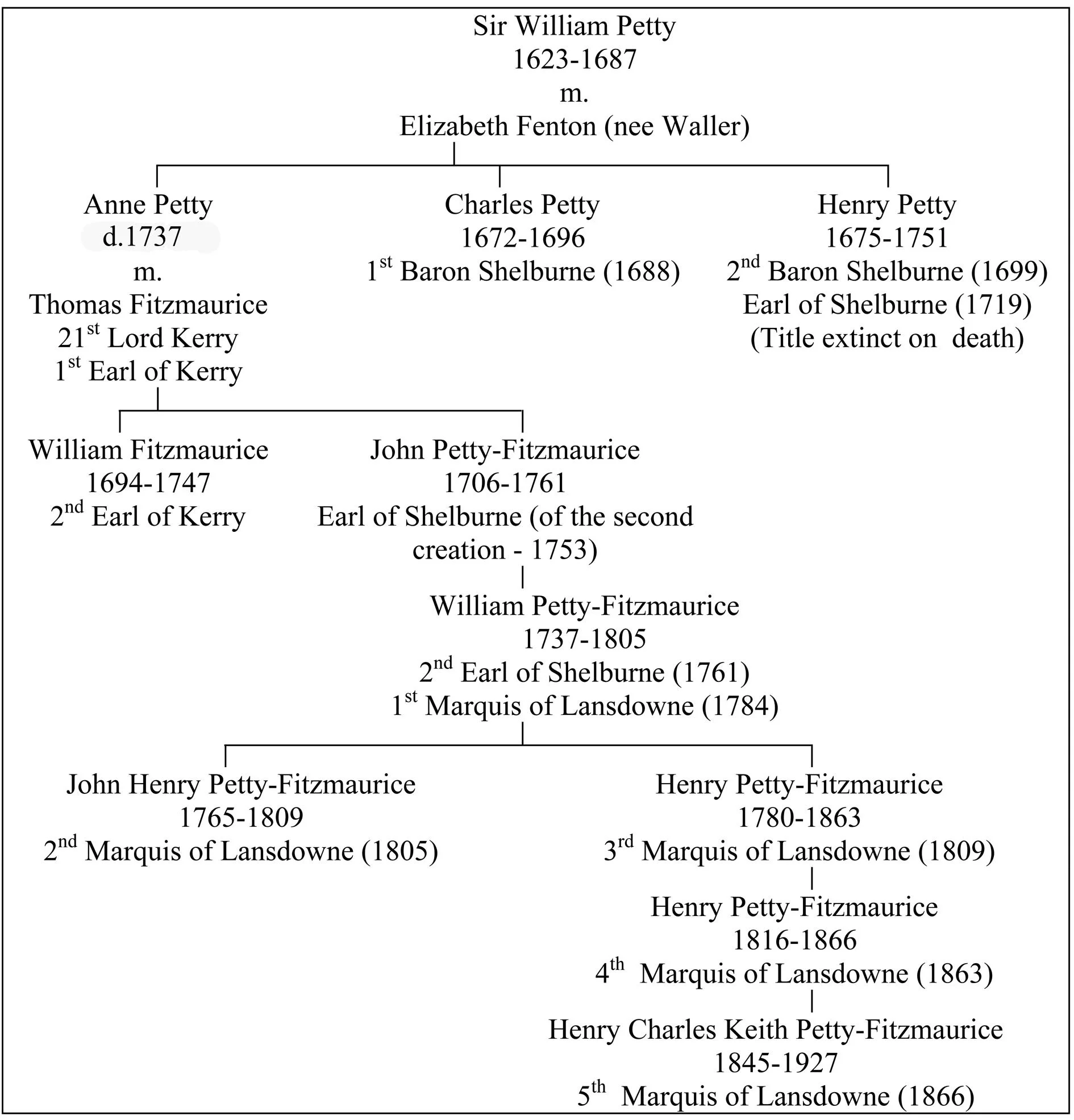
The Pettys and the Petty-Fitzmaurices.
By around 1710, political conditions stabilised in Ireland and England and the value of the Glanarought estate increased. Henry Petty, Lord Shelburne, now sought to contest the ‘Grand Lease or Demise’. Despite the fact that the Pettys had raised no objections when the ‘Grand Lease’ was granted, Shelburne accused James Waller and Richard Orpen of collusion in enacting the lease. On another front, in 1713, Trinity College Dublin sought to recover lands that Robert Topham had leased for a small rent on behalf of the Pettys in 1692-3 during his brief term as Petty agent in Glanarought. Richard Orpen had regarded them as Petty lands in his dealings. ⁴⁹ Richard Maybery’s land at Gortalinny and William Mabury’s land in Currabeg were caught up in the dispute. Both Richard and William became College tenants after the College secured its land (hereafter referred to as the College or Gortagass Estate) in 1714.
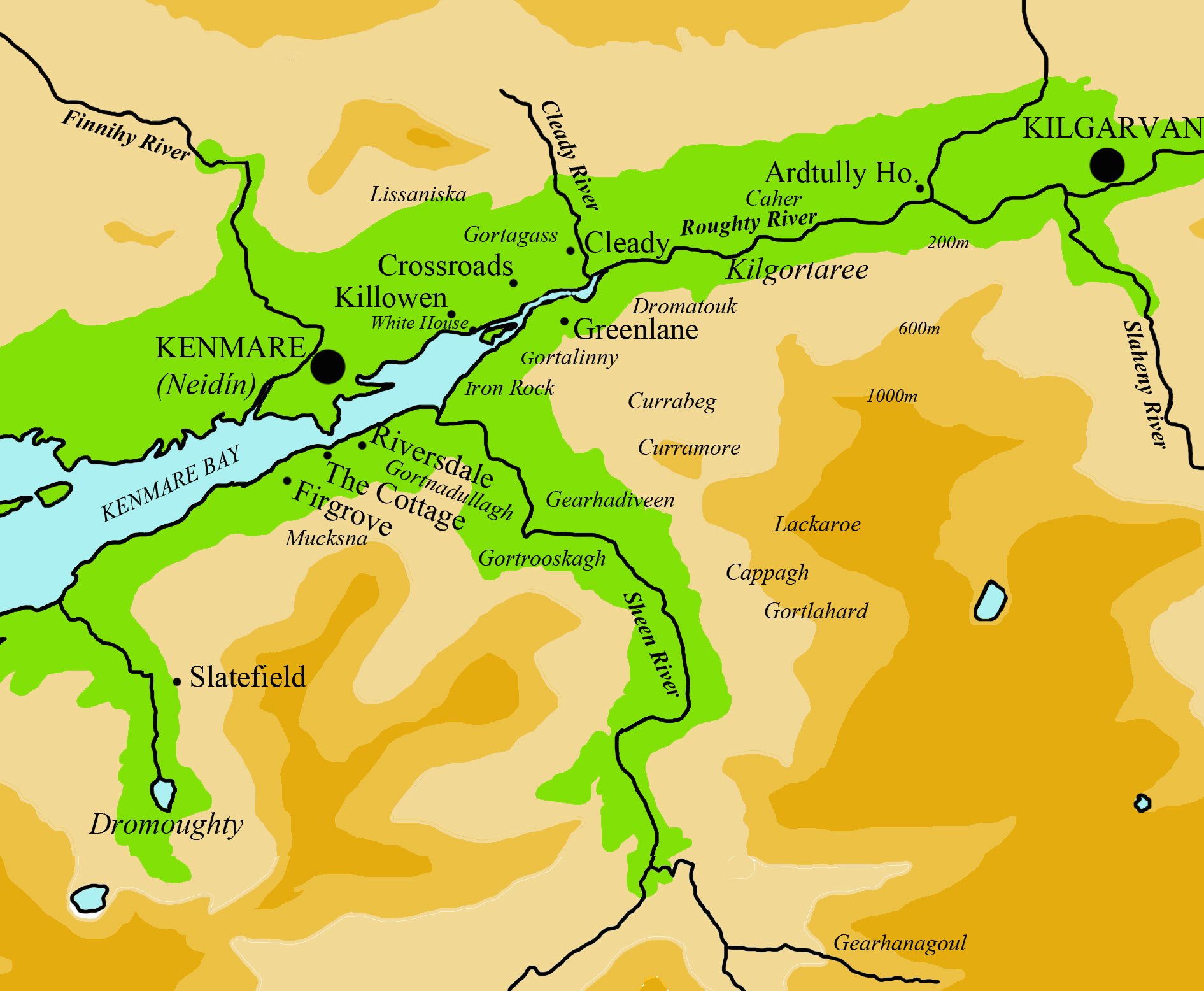
Kenmare, in the barony of Glanarought, and its surrounds.
After Richard Orpen’s death in 1716, the Orpens either lost the drive or could not muster the means (or both) to continue the defence of the ‘Grand Lease’. Around 1720-1721, the family secretly settled with Henry Petty, now Earl of Shelburne, ‘avoiding’ the ‘Grand Lease’ and receiving compensation and lands in return. It was agreed that the ‘Grand Lease’ subtenants would hold their land for the remainder of the 99 years on the lease or until the last of the three lives given in the lease expired. This occurred in 1763, when Mary Crosbie (nee Orpen), the last of those lives, died.⁵⁰ The subsequent negotiations from 1763 to 1773 between the Mayburys and William Petty-Fitzmaurice, Lord Shelburne, over the future of their Kenmare leases produced several important documents.
William Mabury died sometime between 1719, when he provided proof in a legal case (Isabella Orpen vs Lord Shelburne), and 1721/22 when he was described as 'William Mabury of Currabeg, Gent., deceased' in a document.⁵¹ The uncertainty surrounding the Mayberry ‘Grand Lease’ lands must have fallen upon Richard Maybery. Unfortunately, records of Richard’s affairs are even more sparse than those of William Mabury. It is not even known when he died, but his death must have occurred after 1754, when Richard is thought to have negotiated the rents at Dromoughty with its sub-tenants, and before 1763.⁵²
By 1763, Maybury lands: Dromoughty, Gortnadullagh, Gortruska, Gortalinny and Currabeg, were in the hands of a new generation: Augustus Maybury of Gortascrehane (Kilgortaree), William Maybury of Cleady and John Mayberry of Greenlane. From this period, more records have survived detailing Maybury affairs in Kerry. Property records especially provide valuable evidence for determining Maybury relationships at Kenmare and Kerry generally. If, as the 19th century pedigrees suggest, Richard Maybery was the son of William Mabury and the father of brothers Augustus and William Maybury and John Mayberry, it should be reflected in the inheritance of land. If, on the other hand, Richard Maybery was the son of the 17th century hammerman John Mayberry and Augustus and William Maybury were Richard’s cousins and the sons of William Mabury – ie., there were two Maybury lineages at Kenmare - one would expect a quite distinct inheritance of land.
There is some documentary evidence for the first proposition – a single Maybury lineage at Kenmare. In 1763, Augustus and William Maybury and John Mayberry were all tenants at Dromoughty. It is not easy to establish the exact portions of Dromoughty held by Augustus, William and John in the mid18th century. Rentals of the period dealt with Dromoughty as a single unit, randomly nominating either one or all three Mayburys as lessors. However, a document headed ‘Full Rental of Glanerough taken on 25 Oct 1794’ differentiated the several townlands of Dromoughty and listed their lessors in 1796, although somewhat imperfectly.⁵³ This rental was a product of the renewal of the 21-year lease that occurred around the time of William Maybury of Cleady’s death in 1794-5 (this had been preceded by the deaths of Augustus Maybury in 1784-5 and John Mayberry of Greenlane in 1792). It saw the effective division of Dromoughty into discreet portions and assigned to descendants: Duckett Mayberry (son of John Mayberry of Greenlane), James and Augustus Maybury (sons of William Maybury of Cleady) and the Hawkes (beneficiaries of Augustus and his son Bastable Maybury’s estate by marriage). The rental would seem to confirm, in terms of acreage, that the 1763 division of Dromoughty between Augustus, William and John had been essentially even.⁵⁴
Further support for the ‘single Maybury lineage at Kenmare’ theory is found in a report to Lord Shelburne, written by his agent, Samuel Nelmes in the 1780s. Reference was made to Richard Maybery setting the rent payable by the Sullivan tenants at Dromoughty higher than expected on the Glanarought Estate. This occurred in the 1750s, probably when the lease was renewed around 1754.⁵⁵ This seemed to suggest that Richard Maybery had inherited Dromoughty and, so, passed it on to his sons in equal parts. In addition, it seemed that Maybury land elsewhere was being inherited equally by the new generation. In 1764, Augustus and William Maybury held Gortnadullagh and John Mayberry held Gortruska.
However, things are often not as straightforward as they seem. It is interesting that Gortnadullagh, William Mabury’s old residence of 1697/98, was in the hands of Augustus and William Maybury and not, for instance, Augustus Maybury and John Mayberry; while Richard Maybery’s 1716 acquisition of Gortruska was held by John Mayberry and not, for instance, William Maybury. It is difficult to be precise about the Mayburys’ situation on Trinity College’s Gortagass Estate. The College’s policy of managing their properties at arm’s length through the use of middlemen – ‘head landlords’ - resulted in the limited survival of records. Nevertheless, it is clear that there is little evidence of an equal division of property. John Mayberry of Greenlane benefitted singularly from the inheritance of Richard Maybery’s College lands. By 1766, John Mayberry was in possession of College land to the south of the Roughty River, including Currabeg, leased at £24/4/10 per annum. Augustus Maybury was in possession of Kilgortaree in the same region only by virtue of his marriage to the widow of Robert Bowen, rather than having inherited it from Richard Maybery. He leased it at £8 p.a. William Maybury was located north of the Roughty River, having secured land at Cleady by some unknown means. He leased his land at £8/8/0.⁵⁶ Most importantly, John Mayberry, rather than Augustus and William Maybury, inherited Richard’s home and land at Gortalinny (the location of Greenlane).
These patterns of inheritance at Gortnadullagh, Gortruska and on the Gortagass Estate suggest that two inheritance pathways operated at Kenmare: land held by William Mabury passing to Augustus and William Maybury and land held by Richard Maybery passing to John Mayberry of Greenlane. Put simply, two family lineages had settled at Kenmare by c.1711: Maybury and Mayberry. The sudden appearance of a ‘Francis Maybury, Gent., administrator of William Maybury, Gent., deceased’ with an interest in Maybury properties during the leasehold negotiations with Lord Shelburne in 1772 and 1773 not only serves to strengthen this case but it provides insight into the probable relationship between William Mabury and the hammermen Francis and, perhaps, John Mayberry during the late 17th century.
‘Francis Maybury, Gent., administrator of William Maybury, Gent., deceased’, appears to have been the younger brother of William Maybury of Cloghereen, Killarney (d.1803) - William’s son George Maybury later established the family’s residence at Lackabane, Killarney.⁵⁷ Both Francis and William were resident in Killarney in the mid18th century and pursued similar occupations, engaging in timber trading and construction at Killarney.⁵⁸ ‘William Maybury, Gent., deceased’ is considered to be their father. Regardless of his residence and business activities at Killarney, William Maybury of Cloghereen identified himself as ‘William Maybury of Dunguil in the Co. of Kerry farmer’ in his son Richard’s marriage agreement of 1792. So, his father most probably also had resided in Dunguil townland (Dungeel or sometimes Dunghill) in the civil parish of Killorglin, west of Killarney. Indeed, the Killorglin/Tralee area continued to be another discrete centre of Maybury settlement in Kerry into the 19th century.
The Cloghereen Maybury family’s financial interest in Kenmare Maybury property appears to date back to the 1680s. It affected only Dromoughty and William Mabury’s Gortnadullagh property, both acquired in the 17th century after 1686, suggesting that a Cloghereen family forebear had invested in establishing William Mabury at Kenmare and was one of William Mabury’s partners of 1686. The Cloghereen Mayburys held no interest in Richard Maybery’s leasehold at Gortruska, acquired later in 1716.⁵⁹ In 1773, ‘Francis Maybury, Gent.’, signed preliminary indentures of lease over Dromoughty and Gortnadullagh and was present at the signing of the Gortnadullagh lease in 1773. These indentures renounced the Mayburys’ right to perpetuity under the ‘Grand Lease’ for the properties in question which, in this example from the ‘Gortnadillagh’ indenture, carried the clauses (my underlining):
Whereas by Indenture of Lease … the said William Earl of Shelburne hath demised unto the said William Maybury and Augustus Maybury with the consent of the said Francis Maybury, the Town and Lands of Gortnadillagh … for the term of twenty one years from the first day of May last …⁶⁰
In granting consent, Francis was acting as a mortgagee, not a lessee, of the two properties acquired by William Mabury in the mid1680s. Neither of the 1773 leases carried Francis Maybury, Gent’s name, a detail that goes some way in explaining why only William Mabury’s name appears on his leases of 1712 with no mention of his partners and their financial interest in the properties.
One of those partners at Dromoughty was most likely Francis Mayberry of Enniscorthy, one of the hammermen at Glanarought in the 1670s. As has already been explained, Francis Mayberry of Enniscorthy Maybury had a continuing connection with Glanarought until the 1690s at least and was associated with Richard Mabery and ffrancis Mabrey junr., in a civil case brought in 1706. Francis Mayberry of Enniscorthy is also most likely to have been the ancestor, perhaps through his son ffrancis Mabrey junr., of ‘Francis Maybury, Gent.’, and William Maybury of Cloghereen. They were members of a Maybury family lineage with a tradition of naming sons Francis – a given name almost unique among the Maybury families in Kerry - in every generation into the 20th century. Firmer support comes from STR DNA testing which shows that, within the Kerry Maybury R-FTA43422 haplogroup, the Cloghereen Maybury line is genetically distinguishable from the Kenmare Mayberry and Cleady Maybury lines. It is worth noting that the relationship, through marriage and business, between the Cloghereen Mayburys of Killarney and the Greenlane Mayberrys of Kenmare was exceedingly close into the 19th century. It is very likely that this relationship can be traced back to 1686 when Francis Mayberry joined with his fellow hammerman and brother John Mayberry, spouse of Rachel Orpen, father of Richard Maybery of Gortalinny and grandfather of John Mayberry of Greenlane, to partner their younger brother William Mabury in the acquisition of Dromoughty.
For all that, one might see an apparent weakness in this case for the two-family lineage theory at Kenmare. In contrast to the two separate Maybury/Mayberry inheritance pathways seen in Gortnadullagh, Gortruska and on the Gortagass Estate, William Mabury’s holding at Dromoughty, from the information gathered by Samuel Nelmes in the 1780s, does appear to have been inherited by Richard Maybery after William Mabury’s death; then inherited by Augustus and William Maybury and John Mayberry of Greenlane. Additionally, Currabeg, once property of William Mabury, also passed into the hands of Richard Mayberry before it was inherited by John Mayberry of Greenlane. Once again, things are often not as straightforward as they seem. These challenges to the two-family lineage theory can be resolved by examining circumstances at the time of William Mabury’s death.
William Mabury was under dire financial pressure when he died in c.1720. He was in debt and all his leaseholds appear to have been mortgaged. At Dromoughty, the Mayburys’ Sullivan tenants at Dromoughty signed a rental agreement with Richard Orpen’s widow Isabella in 1721. It was recorded that
…William Mabury being in the said Richard Orpen’s Debt Did give and Grant unto the said Richard Orpen A Rent Charge or Mortgage of seven pounds Ster to be paid unto the said Richard Orpen [by the tenants in addition to Mabury’s annual rent]⁶¹
Thus, no rents were to come to the Mayburys from Dromoughty after 1721. In 1724, a memorandum issued by Henry, Lord Shelburne, to his agent directed that the ‘lease to Mabury which was mortgaged to Bastable’ be obtained from Richard Orpen’s eldest son Thomas.⁶² This would seem to relate to the Gortnadullagh and Currabeg lease, which William may have initially mortgaged to Bastable, but had been passed on to the Orpens by 1724. The Bastable involved in this loan was very probably George Bastable of Castleisland, Kerry. It may be significant that an Agnes Mayberry, whose connections are not known other than she was the mother-in-law of Augustus Maybury of Kilgortaree, was married to a Bastable. George Bastable was the grandfather of Thomas Orpen’s wife, Agnes Herbert, and that could have resulted in the lease finding its way into the hands of the Orpens.
It was around 1724 that William’s mortgaged leases were probably offered by the Orpens to Shelburne as a collateral security for their own rental arrears, along with a Mahony lease over Iveragh and Dunkerron that had also found its way from George Bastable to the Orpens.⁶³ This would account for Shelburne’s memo of 1724. As it turned out, Shelburne backed out of this arrangement by 1732 and demanded cash payment for the arrears. The Orpens gathered the sum required by selling the Mahony Iveragh lease to Arthur Crosbie in 1744/5.⁶⁴ It does not appear that William Mabury’s mortgages suffered this fate. William’s debts seem to have been cleared.
There seems little doubt that Richard Maybery, the senior Maybury at Kenmare, played a central role in the settlement of these debts on behalf of the youthful sons of William Mabury. It is quite conceivable that the price paid by William Mabury’s estate for this was the transfer of Currabeg to Richard and the conversion of a financial interest Richard held in Dromoughty, similar to that held by the Maybury family of Cloghereen but inherited from his father the hammerman John Mayberry, into a one-third share of the lease. So, when Richard negotiated the rents at Dromoughty with its sub-tenants around 1754, he was not acting as sole owner, but as a partner in the lease with his cousins, the Maybury brothers Augustus and William. His name was given precedence in records in circumstances commonplace in Shelburne/Lansdowne rental records until 1794.
In summary, Mayberry property records, in common with most early Irish Maybury records, are far from comprehensive, but enough survive to provide important insights into the intrafamilial and extrafamilial relationships of the Kerry Mayburys. Analysing Kenmare Maybury ownership of property and its inheritance seriously questions the previously accepted belief that William Mabury was the progenitor of the Kenmare Mayburys and Mayberrys - that he was the father of Richard Maybery whose children went on to establish two extended Maybury families and one Mayberry family at Kenmare. Instead, the evidence lends support to the argument that two men, William Mabury (youngest son of the master hammerman Thomas Mayberry) and Richard Maybery (son of the hammerman John Mayberry), established families at Kenmare by the first decade of the 18th century: Maybury and Mayberry. The Maybury sons inherited William’s property, still encumbered by one of his partners – Francis Mayberry’s - financial interest from the 1680s, while John Mayberry of Greenlane inherited Richard’s lands. Complicating this transition and confusing later genealogists and descendants, were property adjustments made by Richard Maybery in response to William Mabury’s precarious financial situation at the time of his death in c.1720 that had burdened his young sons Augustus and William. Almost certainly, there were also family arrangements made after William Mabury’s death involving his sons. These may have clouded perceptions of Maybury relationships held by outsiders and even family members in the years that followed, including those held by the young genealogist Richard Hawkes Maybury. Family secrets, such as illegitimacy, and family arrangements, such as fosterage and interfamilial adoption, were rarely exposed in 19th century family pedigrees.
What’s In a Name?
Having considered genetic evidence and the evidence from the limited number of surviving documents in an effort to understand the relationships of Mayburys at late 17th to early 18th century Kenmare, perhaps the clearest indication of two lineages at Kenmare: Maybury and Mayberry, has been hiding for some time in plain sight – in surnames and given names.
As explained early in this paper, there has always been a variety of surname spellings applied to the extended family now referred to as Mayburys. Mayberry appears to have been favoured by 19th century officials in Ireland and could be applied to those bearing the Maybury surname. In earlier centuries, the spelling was often even more creative.
There have been several explanations for the two surnames at Kenmare, Maybury and Mayberry, offered in the past. One suggestion has been that the adoption of the Mayberry spelling was connected to a change in religion within the family at Kenmare. However, the adoption of the Mayberry spelling occurred long before that family’s known conversions to Catholicism in the mid19th century. Another suggestion is that surname spelling was used to socially differentiate Kenmare Maybury families and there is some evidence that this was the case– as Robert James Oliver Maybury commented in his Recollections of Kenmare: ‘As a family with their different spelling of the name [the Mayberrys] were supposed to be awful snobs’.⁶⁵ In one particular instance, William Steuart Trench (1808-72), Lord Lansdowne’s agent at Kenmare, identified four Mayburys and four Mayberrys on his 1858 seating plan for the newly built St Patrick’s church. The plan is a fascinating expression of the social hierarchy existing amongst Kenmare’s resident and non-resident Protestant community as perceived by this influential and powerful local individual. All of the larger Maybury landholders were shown as ‘Mayberry’, despite several being better known as Maybury and despite Trench’s familiarity with the families concerned.⁶⁶ Generally speaking, this seems to have been the practice of outsiders, perceptive of the rising fortunes of the Mayberry family from the latter half of the 18th century, not of the Maybury families themselves.
Robert James Oliver Maybury believed that the Mayberrys ‘took to spelling their name MayBERRY consequent upon a family row in the early years of the 19th century or very late in the 18th’. It could well be that there had been a Maybury-Mayberry argument. If so, it occurred much earlier than Robert Maybury believed: John Mayberry I of Greenlane, favoured the spelling Mayberry when signing documents from at least 1763.⁶⁷ Any such rift was not deep enough to preclude Duckett Mayberry, John of Greenlane’s eldest son, from being invited to act as joint executor of Augustus’ son Bastable Maybury’s will and a trustee for Bastable’s daughter, Mary.
The obvious explanation for the two surname spellings is that they represented two family lineages at Kenmare. The surname Maybury is an obvious extension of William Mabury’s preferred spelling of his surname, as found in documents created in 1697/98; while Mayberry is an extension of Richard Maybery’s preferred surname.
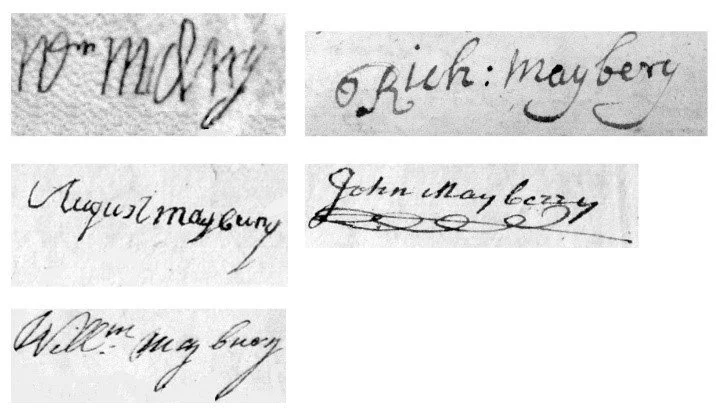
Signatures of (left column, top down) William Mabury, Augustus Maybury of Kilgortaree and William Maybury of Cleady; (right column) Richard Maybery and John Mayberry of Greenlane.
Patterns in given names among the Mayburys and Mayberrys provide additional support. It should be recognised that bestowing given names in 18th and 19th century Ireland was influenced by well-established social conventions and surnames used as given names were often employed to enhance status and familial networks among the Protestant middle-class minority as well as among Catholic gentry families.⁶⁸ This was especially the case among the Kerry Mayburys and Mayberrys.
The continued use of Duckett as a given name in all 18th and 19th century Greenlane Mayberry generations was almost certainly a celebration of Richard Maybery’s marriage to Mary, the sister of his neighbour William Duckett. It was not used among the Cleady Mayburys, which is understandable if it is accepted that their ancestor was not Richard Maybery, but William Mabury.⁶⁹ The Ducketts seem to be the source of another surname, Hyland, that endured as a given name with various spellings among Mayberrys from the 18th century into the 20th century, but it is again absent among Kenmare Mayburys.⁷⁰ Once again, it is understandable that the Cleady Maybury line is replete with Williams and Augustuses if it is accepted that William Mabury was father to the brothers Augustus and William Maybury. Yet, there is a complete absence of William and Augustus as given names in the 18th and 19th century Mayberry family. In the Mayberry family, that considered itself descendants of Rachel Orpen, unsurprisingly Rachel was bestowed as a given name on the daughters of her Mayberry grandson and two of her Mayberry great-grandsons. It seems that a Rachel was unknown amongst the Kenmare Mayburys until 1898.
18th Century Maybury Branches
Having explored the establishment of two families, Maybury and Mayberry, at Kenmare with the involvement of a third Maybury family, originally settled at Dungeel, Killorglin, then relocating to Cloghereen in Killarney by the mid18th century, questions arise as to their connections with another two (perhaps three) Maybury families, prominent in the Kenmare-Killarney region: the Mayburys of Gortnadullagh-Gearhanagoul and the Mayburys of Muckross, Killarney.
The possibility that the hammerman John Mayberry’s financial interest in the acquisition of Dromoughty in 1686 had been settled by the transfer of a third portion of the land during the time of his suggested son, Richard Maybery, is given some support from what seems to have been a similar, related transaction in Gortnadullagh in 1796. The death of William Maybury of Cleady in 1794, the last of the three Kenmare Maybury/Mayberry leaseholders of 1763-73, brought about the effective division of Dromoughty between the Hawkes family (beneficiaries by marriage of the estates of Augustus and Bastable Maybury of Kilgortaree), the Mayberrys of Greenlane and the Cleady Mayburys by 1796. As for Gortnadullagh, it was held by Mary Maybury (widow of Augustus Maybury), James Maybury of Slatefield (son of William of Cleady) and a John Maybury who could not be traced to any Kenmare family.⁷¹ It is possible that this John Maybury of 1796 was the son of William Maybury of Cloghereen and his acquisition of a third part of Gortnadullagh was the final settlement of the financial interest long held by the Cloghereen Mayburys in William Mabury’s 17th century Kenmare properties. Unfortunately, apart from a mention in a summary of William of Cloghereen’s will, written by Francis Maybury Hilliard in 1933, nothing is known of his son John apart from the likelihood that he was born c.1770, as would be expected of John Maybury (1796) of Gortnadullagh.⁷²
By the time the Griffith’s valuation was taken in 1852, Gortnadullagh was in the possession of an Anne Lovett (probably as a result of the settlement of the estate of Mary Maybury who died c.1802), Samuel Maybury (son of James Maybury of Slatefield) and John Maybury. This John Maybury of Gortnadullagh (1801-1881) was almost certainly the eldest living son of John Maybury of 1796. The names of some other children of John Maybury of 1796, all likely born in the first decades of the 19th century, can be found in other documents. One of the more challenging of these documents was created by John Maybury of 1796’s grandson, William Maybury (c.1845-c.1922) of Kansas, who attempted a family history during the early 1900s. William confirmed a John as one of John Maybury of 1796’s children and identified several others: his father Thomas (who later lived in Oswaldtwistle, Lancashire, England), James Duckett, George and William.⁷³ Very likely William of Kansas overlooked daughters, perhaps one of whom, Mary Maybury of Gortnadullagh, married Cornelius Sullivan on 13 February 1820 with George Mayberry as one of the witnesses. It appears that William of Kansas had only a vague notion of his uncles’ lives, unsuccessfully attempting to locate them in the course of his efforts to investigate his family’s relationships. Unfortunately, William of Kansas merged what he knew of his family with a good deal of accurate information on various other Mayburys/Mayberrys in Kerry but in a way to create his own, rather inaccurate family history. Nevertheless, Thomas Maybury of Lancashire’s marriage certificate confirms that his father was John Maybury, farmer of Kenmare, although the date of Thomas’ birth is unclear having been variously reported as occurring sometime between 1813 and 1819.⁷⁴ Recollections by other descendants of John Maybury of 1796 have also assisted in identifying John Maybury’s son, George, as George Maybury of Gearhanagoul, a townland in Bonane, approximately 13 kms south-east of Kenmare. George married a Sullivan in 1836. His great grandson recollected that George’s early home lay in ‘the falls area of Kenmore’, apparently the Sheen Falls in the townland of Gortnadullagh. He was probably the George who witnessed Mary Maybury of Gortnadullagh’s marriage in 1820.⁷⁵ What was critical in linking John Maybury of 1796 to John Maybury, son of William Maybury of Cloghereen, and in connecting the Maybury families of Gortnadullagh, Gearhanagoul and Oswaldtwistle, Lancashire, was their continued use of the surname Duckett as a given name. While Duckett was also used as a given name by the Mayberrys of Greenlane after the marriage of Richard Maybery to Mary Duckett in the early 18th century, in this instance it appears to have celebrated the marriage of John of 1796’s suspected brother George Maybury of Lakeview (d. 1846) to Isabella Duckett in 1804. Isabella Duckett was the daughter of Thomas Duckett and Mary Mayberry, daughter of Augustus Maybury of Kilgortaree. Thomas Duckett’s children included several prominent legal officers, one being Richard Mayberry Duckett (c.1789-1866). The given name Duckett was also bestowed on George of Lakeview’s son, Dr Thomas Duckett Maybury (c.1816-1877) of Tralee, Kerry. It would be extraordinary, given the social practices of the day, that the Gortnadullagh and Gearhanagoul families would celebrate a Duckett connection in an unrelated family.
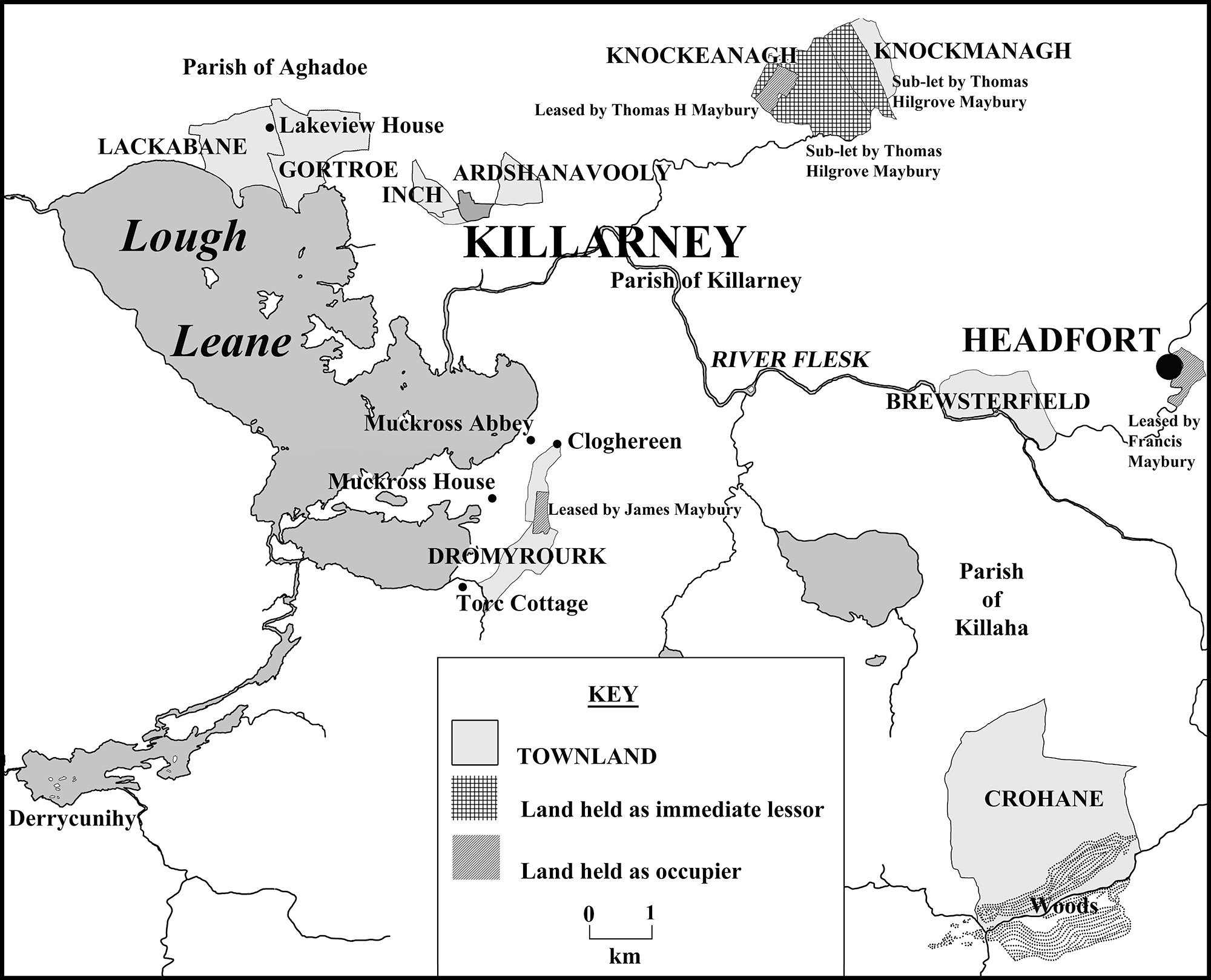
Maybury lands at Killarney, co. Kerry, c.1850.
The origins of another Maybury family with links to Killarney are equally elusive. Their association as stewards with the Herbert family of Muckross House, Killarney, has led to them being described as the Mayburys of Muckross. Perhaps the best-known members of this branch of the Kerry Mayburys are James Maybury (c.1799-1870) and his wife, Maria Shaw. James would appear to have been the son of William Maybury of the parish of Killaha. Killaha parish was located between Kilgarvan and Killarney and was merged with Kilgarvan parish in 1812. In 1834, William and Ann Maybury of Killaha parish were included in a ‘List of Protestant Inhabitants’ of the parish of Kilgarvan along with a group presumed to be their children: James, Rebecca, Francis, William, Fanny, Anne and Mary.⁷⁶ Another child, Elizabeth, is missing from this list due to her marriage to William Bowen of Kenmare parish in 1832. It is very probable that William of Killaha held 313 acres, in partnership with Maurice Spillane, in Crohane townland in the parish of Killaha in 1833.⁷⁷ It would appear that his son James was an adult in 1834 since James served as a vestreymen in the parish in 1833. It seems that he married Maria Shaw around 1835. In 1837, he was identified as James Maybury of Crohane (the location of William Maybury’s leasehold in 1833) when serving as churchwarden at Kilgarvan. James was again churchwarden at Kilgarvan in 1842, but was then living at Glen Flesk Wood. This was just after the baptism of Anne Marie, daughter of James Maybury and Maria Matilda Maybury, recorded in 1840 at Kilgarvan.⁷⁸
It has been claimed that William Maybury of Killaha was the son of William Maybury of Cleady and Mary Aldworth, seemingly based on the genealogical notes written by Richard Hawkes Maybury in 1865 that identified a William Maybury among their sons. The claim seems reasonable, particularly as William Maybury of Killaha cannot be easily placed in any other contemporary Maybury family in the Kenmare/Killarney region. Indeed, no evidence of important social and financial interactions between the Mayburys of Muckross, their neighbours the Cloghereen Mayburys or the Mayberrys of Kenmare has been located. Instead, there was a case of intermarriage between the Muckross Mayburys and the Cleady branch of the Mayburys.⁷⁹ Also lending some support to William’s possible link to the Cleady Mayburys was the presence of a Samuel Maybury, the name of another of William of Cleady’s sons, on the ‘List of Protestant Inhabitants’ at Kilgarvan in 1834. Samuel also served as a vestreymen in the parish of Kilgarvan, alongside William Maybury and James Maybury in 1833.
Towards a new Kerry Maybury Family Tree
We can now summarise the findings of Y-DNA SNP testing and the reappraisal of documentary evidence and propose a new family tree, incorporating not only the Kenmare Maybury and Mayberry families, but some other Maybury families across south-west County Kerry.
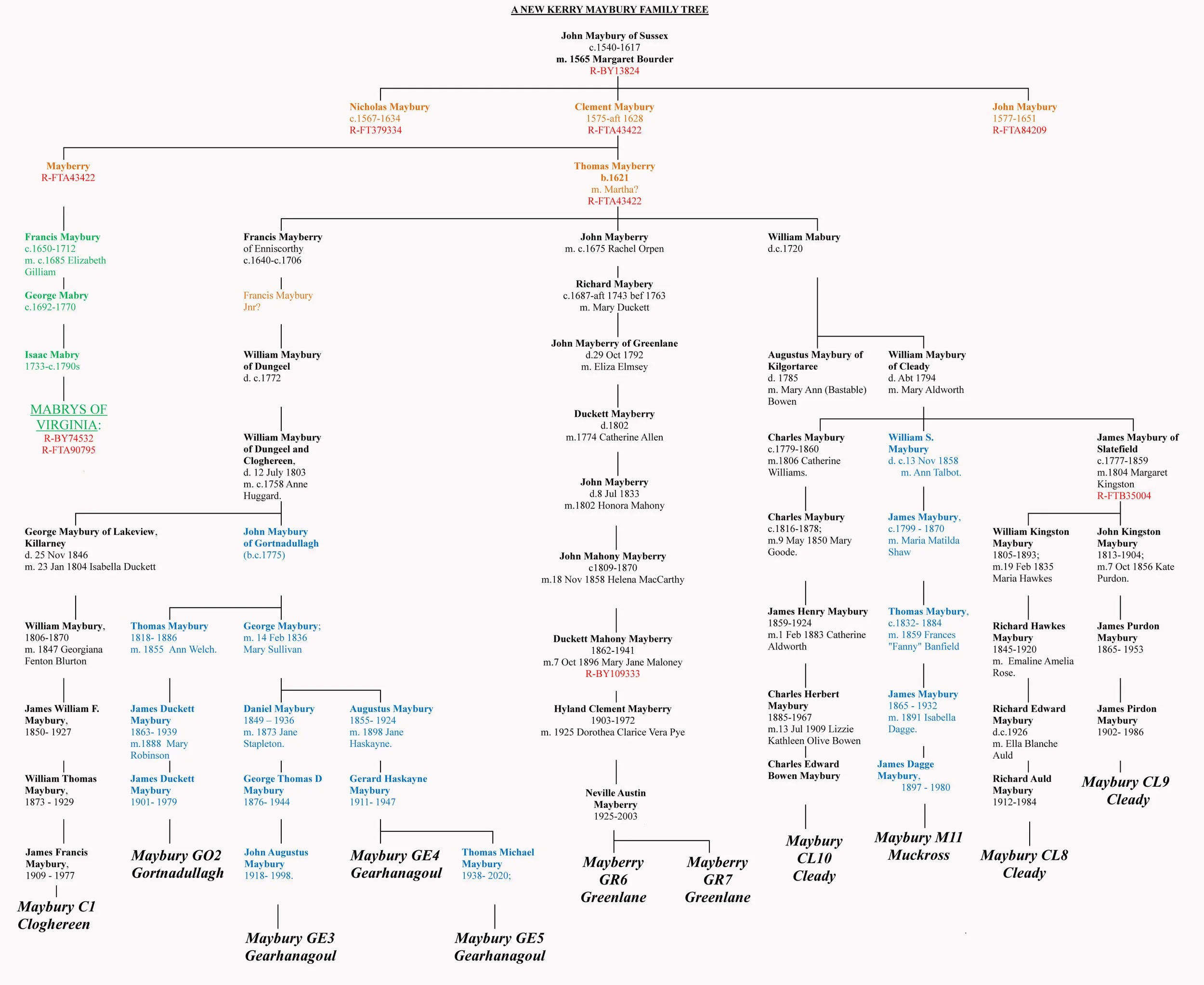
Figure 1. A New Kerry Maybury Tree.
Only the lineages of those who have taken the BigY test are shown in this tree with the exception of Maybury GO2’s line. Entries for individuals in black type are well-established or proven; those in blue belong to lineages whose connections to other Maybury families were previously uncertain; those in orange have been established by DNA testing and some documentary evidence or are otherwise conjectural (shown as ?). The closely-related Mabry family branch (Francis Maybury of Virginia) is shown in green. Genetic variations (SNPs) identified by BigY tests, relative to certain lines, are shown in red.
Unfortunately, it will never be possible to produce a comprehensive Kerry Maybury family tree even within this geographical area. For example, it is almost impossible to account for numbers of Maybury sons and daughters who lived in Kerry during the 18th and 19th centuries whose names are preserved as mere mentions in surviving documents, only rarely with some historical context. Two examples come to mind that have some bearing on issues presented in this paper: Agnes Mayberry, known only as the mother-in-law of Augustus Maybury of Kilgortaree, who was married to a Bastable (perhaps George), mortgagee of William Mabury; and John Maybury, church warden of Kilgobbin parish (near Tralee and Killorglin) in 1758, who would appear to have been an early member of the Maybury family of Dungeel, Killorglin. Some are anonymous, such as the seven unnamed daughters of William Maybury of Cleady and Mary Aldworth.⁸⁰ Only a lucky percentage of individuals can be incorporated into a Kerry Maybury family tree. The New Kerry Maybury family tree presented here incorporates only those lineages that have been defined by BigY DNA testing. Nevertheless, it provides a genealogical framework into which related Mayburys, including the aforementioned isolated, obscure Maybury individuals and families, may find their place.
The first three generations of a New Kerry Maybury Family Tree have been identified due to insights obtained from DNA testing, supplemented by traditional genealogical investigation. It is accepted that the Kerry Mayburys’ earliest known ancestor was John Maybury, hammerman of Sussex, who carried the genetic variation R-BY13824, and his son, the hammerman Clement Maybury, who is believed to have carried the genetic variation R-FTA43422. Clement’s son, Thomas (bp.1621) is claimed to be Thomas Mayberry, master hammerman of Enniscorthy, Wexford, and sometime Glanarought, Kerry. Counted as his sons are the hammermen Francis Mayberry of Enniscorthy and John Mayberry. The names of all three hammerman are found on a list of workmen at Glanarought compiled in c.1672. Not found on the list was William Mabury, claimed as a younger son of Thomas Mayberry. These men are all claimed as ancestors of Kerry Maybury families who carry the genetic variations R-BY13824>R-FTA43422.
Also included, for reference, on the New Kerry Maybury Family Tree is the parallel R-FTA43422 line headed by Francis Maybury of Surry County, Virginia. Francis Maybury who died in 1712 is considered a contemporary of the hammerman Francis Mayberry of Enniscorthy and another grandson of Clement Maybury, although by an unknown father. Francis of Virginia’s descendants subsequently took to spelling their surname as Mabry. Francis Mayberry of Enniscorthy’s family line is not clearly defined in the early 18th century. It is possible that the family was first established in western Kerry by his son Francis junior – the second in a series of Francis Mayburys (and a Frances Maybury) that graced the family into the 20th century. Apart from their genetics and a naming tradition, their connection to the hammerman Francis Mayberry is supported by their apparent interest in William Mabury’s property acquisitions at Kenmare dating back to 1686.
It is the next two layers of the New Kerry Maybury Family Tree, covering the periods c.1670 to 1690 and the first two decades of the 18th century, that will be seen as most controversial. Their story is of a family of ironworkers enticed to post-Cromwellian Ireland and then to Glanarought in Kerry as part of an expansion of the English iron industry that sought to exploit expropriated Irish woodlands.
It is most likely that John Mayberry, the third Mayberry hammerman on the list of ironworkers employed at Sir William Petty’s Glanarought ironworks compiled in c.1672, married Rachel, sister of Petty’s clerk Richard Orpen. The Mayberrys and Richard Orpen were both in Glanarought in the early 1670s. It is conceivable, given Richard Orpen’s later iron-making efforts, that he saw value in a close connection to a family of influential ironworkers. As Goddard Henry Orpen concluded, it is highly probable that Rachel (and her sisters) married in the 1670s. John Mayberry is presumed to have been available for marriage in Glanarought at that time; William Mabury was not. He is only known at Glanarought a decade and a half later. Genetic evidence points to a close relationship between William Mabury and the three Mayberry ironworkers. However, he was not on the c.1672 list of Glanarought ironworkers. The most probable reason for this is that he was a child in 1672 and a younger son of master hammerman Thomas Maybury of Enniscorthy (and grandson of the English hammerman Clement Maybury). Their short stay in Glanarought had convinced the Mayberrys of the possibilities offered by Sir William Petty’s ‘plantation’. So, despite belonging to an ironworking family, William’s main interest in the 1680s appears to have been an investment in land in Glanarought. His affidavit of 1692/3, which aimed primarily at restoring his property on the Petty plantation, only hints at his personal history: his settlement at Kenmare with the support of partners, his Englishness and an association with Sir William Petty’s plans for Glanarought. Much was left unsaid, no doubt considered irrelevant to his immediate financial concerns.
The New Kerry Maybury Family Tree rejects the commonly held belief that William Mabury was the progenitor of both the Maybury and Mayberry families at Kenmare. Instead, it is claimed that two men, William Mabury and Richard Maybery (son of the hammerman John Mayberry), established families at Kenmare by the first decade of the 18th century: William heading the Maybury family and Richard heading the Mayberry family. Although tracing the inheritance of Maybury property in the early 18th century has seemingly been confused by financial adjustments following Mabury’s death in c.1720, it is clear that Augustus and William Maybury inherited their father William Mabury’s property, still encumbered by his partner Francis Mayberry’s financial interest from the 1680s, while John Mayberry of Greenlane inherited Richard Maybery’s lands. This pattern of inheritance extended to the passing down of surnames: Mabury to Maybury and Maybery to Mayberry, and several given names.
Kerry Maybury genealogy is better known from the 1770s and this is shown in the third, largest and final layer of the tree. By that time, it is apparent that three main family branches: one Mayberry and two Mayburys, had been established in Kenmare. Ony two lineages, those headed by William Maybury of Cleady and John Mayberry of Greenlane, endured beyond another generation. In adjacent Killarney, the family line headed by William Maybury of Cloghereen (d.1803), arguably a descendant of the hammerman Francis Mayberry of Enniscorthy, can also be traced with some certainty.
Less certain are the relationships of Maybury families associated with Gortnadullagh, Gearhanagoul and Muckross to the main Kenmare Maybury and Mayberry families and the Mayburys of Cloghereen. DNA testing has suggested a link between a descendant of a Gortnadullagh Maybury family and an extensive Gearhanagoul (Bonane) Maybury family and there is some documentary evidence to support this. These two family lines are shown in blue type on the New Kerry Family Tree. The evidence for the Gearhanagoul and Gortnadullagh Mayburys being a branch of the Mayburys of Cloghereen is based on the adoption of the Duckett surname as given names among Gortnadullagh and Gearhanagoul Mayburys, mention of a son John Maybury in the will of William Maybury of Cloghereen (1803) and the transfer of land at Gortnadullagh to a John Maybury in 1796 following the death of William Maybury of Cleady.
Also shown in blue type is the Muckross Maybury family line. It is probable that this is a branch of the Cleady Mayburys headed by William, son of William Maybury and Mary Aldworth. William lived in the Killaha-Kilgarvan area, north-east of Cleady, which was also the residence of Samuel Maybury, another of William Maybury of Cleady’s son. While there is no evidence yet for any significant 18th or 19th century connection between the Muckross Mayburys and the Mayburys of Clogherheen, there is at least one instance of intermarriage with the Cleady Mayburys.
DNA’s Last Word
Having proposed a New Kerry Maybury Family Tree on the basis of results obtained from FTDNA’s Next Generation Sequencing (NGS) test, BigY, and from the review of genealogical and historical evidence, it is most useful to consider to what extent can it be verified from further analysis of DNA test data obtained from descendants of the various Kerry Maybury families.
BigY testing has had the added advantage of providing STR (Short Tandem Repeat) data from 111 sites on the Y chromosome, an improvement on earlier testing of 37 sites. An analysis of this data was carried out by David McConnell, Fellow Emeritus at the Smurfit Institute of Genetics, Trinity College Dublin. As has already been outlined, BigY tests were undertaken by descendants of two Kenmare family lineages, those headed by William Maybury of Cleady and John Mayberry of Greenlane, as well as descendants of three other Kerry Maybury families: the Mayburys of Muckross, Killarney, whose head was believed to have been a son of William Maybury of Cleady; the Mayburys of Cloghereen, Killarney; and the Mayburys of Gearhanagoul, Kenmare. Y37STR data from a descendant of the Gortnadullagh Mayburys, considered close relatives of the Gearhanagoul Mayburys, was also available. Now deceased, he was the only descendant of this lineage to have undertaken DNA testing.
To address issues of privacy, the Kerry Maybury descendants are identified by code. Their family affiliations are as follows:
C1 - Cloghereen Mayburys
GO2 -Gortnadullagh Mayburys - Y37 sample, not included in the DNA tree
GE3 - Gearhanagoul Mayburys
GE4 - Gearhanagoul Mayburys
GE5 - Gearhanagoul Mayburys
GR6 - Greenlane Mayberrys
GR7 - Greenlane Mayberrys
CL8 - Cleady Mayburys
CL9- Cleady Mayburys
CL10 - Cleady Mayburys
M11- Muckross Mayburys
The DNA results from ten of these eleven individuals (GO2 having only tested for 37 markers) are very similar; STR markers are the same at almost all the BigY STR sites. However, differences do occur in 21 of the 111 STR sites tested in Big Y 111 (note that some STRs have multiple independent sites; for example, DYS464 has 4 sites - 15-16-17-18). The sites at which differences occur in these ten people are:
DYS389i 13; DYS389ii 29; DYS458 19; DYS459 9-10; DYS449 29; DYS464 15-16-17-18; YCAII 19-22; CDY 36-39; DYS481 22; DYS714 26: DYS589 12; Y-GATA-A10 13; DYS712 19; DYS532 14; DYS504 17.
The total number of mutations at these sites is quite small and suggests that male Kerry Mayburys have a Most Recent Common Ancestor (MRCA) with this set of STR markers (haplotype) who lived a few hundred years ago.
The proposed Kerry Maybury MRCA haplotype is identical to the Kerry Maybury Modal Haplotype, the set of STRs that occurs most often among Kerry Maybury descendants at some chosen sites on the chromosome (generally, such a correlation need not necessarily be the case, since a Modal Haplotype and a MRCA haplotype are derived in different ways). The Kerry Maybury MRCA haplotype is the set of STRs in the most recent common ancestor that was passed on with occasional mutations to his descendants.
It is also interesting that the modal haplotype of the Kerry Mayburys is almost identical to the MRCA and modal haplotype of the Mabry descendants of Francis Maybury (d.1712) of Surry County, Virginia. It will be recalled and it is shown in the New Kerry Maybury Family Tree, that Francis Maybury of Virginia has been claimed as a first cousin of his contemporary, the hammerman Francis Mayberry of Enniscorthy. Both the Kerry Mayburys and the Virginian Mayburys carry the SNP R-FTA43422 and the modal haplotypes of the two family branches show just two differences (shown below in bold): DYS391 and CDY, which is a marker that mutates faster than any other site in the BigY111 test:
Virginian Maybury Modal Haplotype [including the STR DYS391]
DYS391 12; DYS389i 13; DYS389ii 29; DYS458 19; DYS459 9-10; DYS449 29; DYS464 15-16-17-18; YCAII 19-22; CDY 36-40; DYS481 22; DYS714 26: DYS589 12; Y-GATA-A10 13; DYS712 19; DYS532 14; DYS504 17
Kerry Maybury MRCA and Modal Haplotype [with DYS391 added]
DYS391 11; DYS389i 13; DYS389ii 29; DYS458 19; DYS459 9-10; DYS449 29; DYS464 15-16-17-18; YCAII 19-22; CDY 36-39; DYS481 22; DYS714 26: DYS589 12; Y-GATA-A10 13; DYS712 19; DYS532 14; DYS504 17.
All ten Kerry Maybury descendants have DYS391 11 and eight out of ten have CDY36-39. These are the sites that distinguish the Virginian Mayburys from the Kerry Mayburys.
In fact, when we consider the Modal DNA Haplotypes for all 111 markers, 108 are identical for the Kerry and Virginia Mayburys. This close relationship is consistent with the claim for a common descent from Clement Maybury (b.1575). Indeed, the Modal Haplotypes for all three major branches of the Mayburys, R-FTA43422, R-FT379334 and R-FTA84209, are remarkably similar, consistent with the historical data that all trace to a common ancestor, John Maybury of Sussex (b.1540).
Returning to the ten Kerry Maybury descendants who have undertaken the BigY test, they have inherited a Ychromosome which is almost identical to that of their MRCA. As expected, as generations have passed, mutations have accumulated along the Maybury family lines on 21 of the 111 STR sites tested in Big Y, and these new STR markers have been passed on to descendants, leading to lines with distinct DNA haplotypes. Mutations are rare and once they occur they remain ‘fixed’ – though there may be very rare exceptions to this rule.
A tree can be constructed from the STR DNA data showing how all the Kerry Mayburys may have descended from their Most Recent Common Ancestor. The advantage of using STRs in this process rather than SNPs (Single Nuclear Polymorphisms) is that they represent a larger amount of data.
The DNA tree is constructed in a way that invokes the smallest number of mutations. It is generated by starting with the grouping of Maybury descendants. The individuals who are genetically most similar, are placed in groups at the bottom of the tree. The descendants (usually two people) in each group can be put on the ends of two branches which lead back to a Common Ancestor at a branch point. The branch point is the common ancestor or MRCA of those few people below. One or more mutations can be identified that must have occurred in one or other of the branches from that common ancestor. Once that common ancestor or MRCA is identified, we deduce his haplotype. Having defined as many groups as possible we then identify which of the groups are most closely related and combine them identifying an MRCA for all the members of the higher level group. And so on, back to the MRCA who is the putative ancestor of all ten Mayburys.
Figure 2 illustrates the results of this process. We can take as an example the Cleady Maybury descendants CL8 and CL9. They are very similar genetically, but each possesses unique mutations: CL8 has two STR mutations at sites CDY (36-39 mutating to 36-38) and DYS714 (26 to 25) while CL9 has one mutation DYS458 19 to 21. These define the two branches leading from their MRCA to CL8 and CL9 (their respective mutations are shown alongside the branches in Figure 2). Both CL8 and CL9 share the mutation DYS504 17 to 18. This is the STR mutation that indicates the branch point and is the decisive feature of the haplotype of CL8 and CL9’s common ancestor.
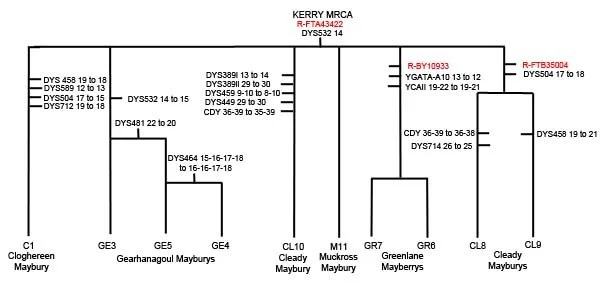
Figure 2. Kerry Maybury tree based purely on Y-111 STR DNA testing.
The DNA tree can be developed further if we identify a further descendant (or descendants) who is closely related to our initial two descendants. Another branch is drawn further up the tree which brings this new descendant (or descendants) onto the branch. This leads back to an earlier common ancestor, the ancestor who is common to at least three people who have been tested. We can assign a haplotype to that common ancestor.
Once again, Figure 2 illustrates the process. Gearhanagoul Maybury descendants GE4 and GE5 are very similar. GE4 and GE5 are grouped together on two branches (as we have seen previously with the two Cleady Mayburys) with GE4’s branch defined by the mutation DYS464 15-16-17-18 to 16-16-17-18. Both GE4 and GE5 share the mutation DYS481 22 to 20. This is the STR mutation that indicates the branch point and represents the haplotype of GE4 and GE5’s common ancestor. However, GE3 is also closely related to GE4 and GE5, and it can be linked to the GE4/GE5 branch further up the tree to an earlier Common Ancestor with the mutation DYS532 14 to 15. DYS532 14 to 15 is the decisive mutation in the MRCA of all three descendants GE4, GE5 and GE3. Incidentally, the Gortnadullagh Maybury descendant GO2, who had only 37 markers tested and is not shown in Figure 2, can be placed closest to GE3 on the basis of his limited test results. This lends support to the theory that the Gearhanagoul and the Gortnadullagh Mayburys share a common ancestor in John Maybury, farmer of Gortnadullagh in 1796.
When the same process is applied to the Greenlane Mayberry descendants GR6 and GR7 we end up with three key groups or main branches: Greenlane Mayberrys and Cleady and Gearhanagoul Mayburys, all with a common ancestor who we call the Kerry Maybury MRCA.
Consistent with the STR data are the two SNP mutations R-BY10993 and R-FTB35004, identified in the BigY testing of descendants, which can be incorporated in the tree (shown in red print). The fact that these two SNPs can be easily be accommodated in the STR tree provides validation of the STR tree.
Figure 2 is disappointing in that it gives no information about how three Mayburys C1, CL10 and M11 are related to the three groups associated with Cleady, Gearhanagoul and Greenlane.
There are four mutations from the MRCA to the Cloghereen Maybury C1, five mutations to the Cleady Maybury CL10, and no mutations to the Muckross Maybury M11. The DNA data alone cannot allow us to say if any of these are linked to any of the three groups. So, they are shown in Figure 2 as descended by separate lines from the MRCA.
The DNA data does, however, exclude many possible relationships between C1, CL10 and M11 and the other seven Mayburys. The question then arises as to whether the DNA evidence for C1, CL10 and M11 is consistent with the genealogical evidence.
Figure 3 shows how each of these three lines to C1, CL10 and M11 can indeed be linked to one or other of the three main branches in the DNA tree when genealogical evidence is taken into account. First consider CL10. The genealogy tells us he is expected to be a member of the Cleady group and so he should be joined to CL8 and CL9 in the Cleady branch. Second, the genealogical evidence favours a link between the Muckross Mayburys with the Cleady Mayburys, so M11 should be attached to CL8, 9 and 10. Third, genealogical evidence favours a relationship between the Cloghereen and the Gortnadullagh/Gearhanagoul Mayburys, so C1 should be joined to the GE3,4,5 branch.
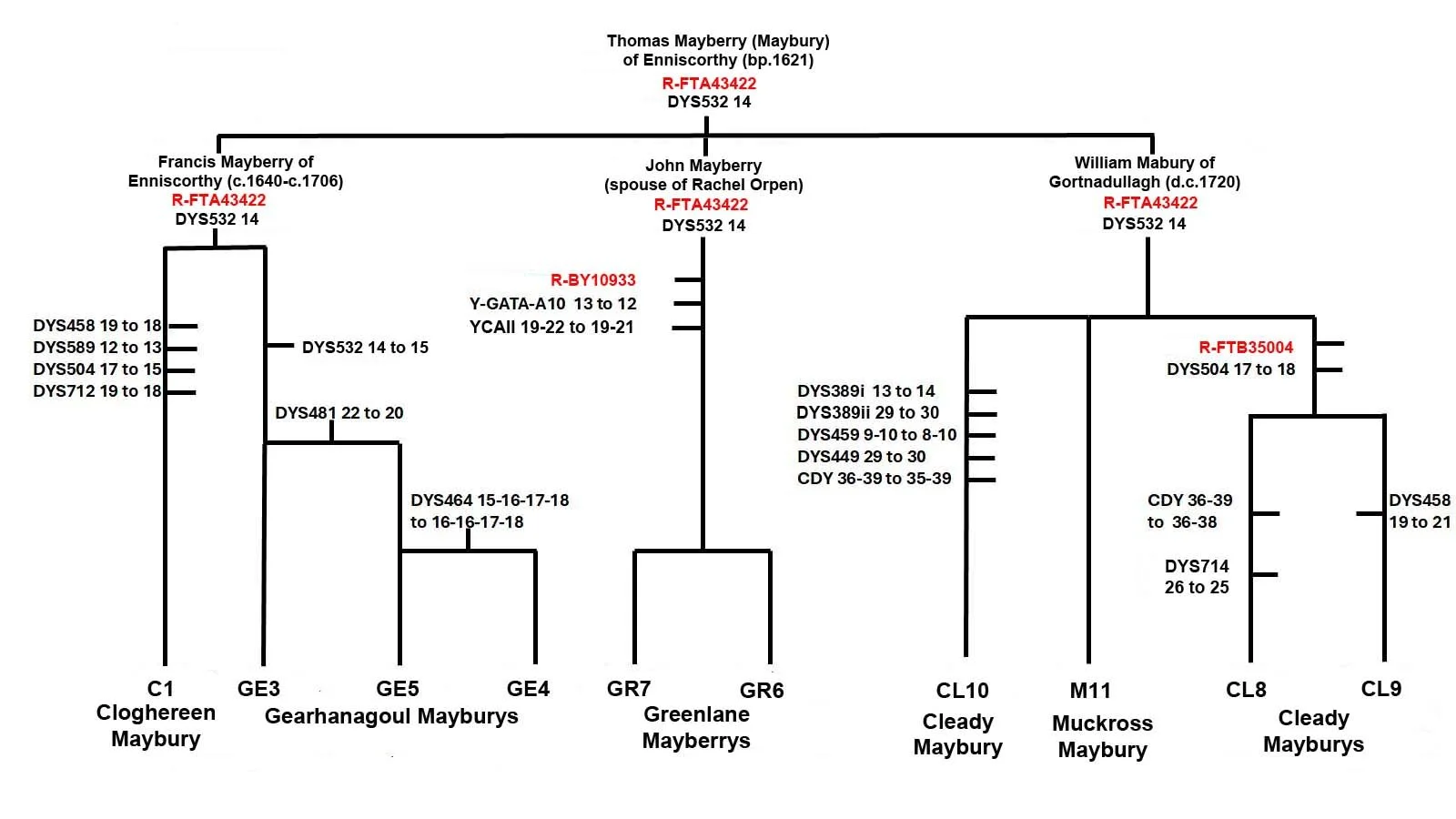
Figure 3. Kerry Maybury tree based on Y-111 STR DNA testing combined with genealogical evidence used to construct the New Kerry Maybury Tree (Figure 1).
It can be seen in Figure 3 that C1, CL10 and M11 can be attached at specific points to two of the three groups [Cleady and Gearhanagoul] already identified in Figure 2, without disturbing the integrity of those two groups. Thus all ten Mayburys can be accommodated in one or other of the three branches of the DNA tree, consistent with the existing DNA data.
Thus, the DNA evidence incorporated in the New Kerry Maybury Family Tree is consistent with the claim that three lineages of the Kerry Mayburys were headed by Francis Mayberry of Enniscorthy, John Mayberry (and his son Richard Maybery) and William Mabury of Gortnadullagh, whose common ancestor, the Kerry MRCA, was their father Thomas Mayberry (b.1621), hammerman of Enniscorthy (son of Clement Maybury [b.1575] and grandson of John Maybury of Sussex [d.1617]). These names have been included in Figure 3.
Conclusion
It would be most satisfying to conclude this paper with a definite and proven genealogy of the Maybury families of County Kerry, Ireland. Unfortunately, that is unlikely ever to be realised. History and genealogy rests upon documents, written evidence, and they are few and far between when tracing the story of the 16th, 17th and even some of the 18th century Mayburys. What documents have survived must be mined for whatever evidence they yield and subject to interpretation. New evidence has emerged through the science of genetics, through ‘documents’ written in the code of Maybury DNA. It has provided new and important insights, but it too has limitations. This paper presents our current understanding of this family, but there always remains the chance that new documents will be discovered and new DNA tests performed that will demand future revision.
Nevertheless, what is presented is a substantial reassessment of the genealogy of the Maybury/Mayberry families in Co. Kerry, Ireland. For some time, the genealogical and historical work of the Orpen family and the 6th Marquis of Lansdowne has shaped understanding of Maybury and Mayberry family relationships, promoting the idea that one man, William Mabury, established the families at Kenmare, Co. Kerry. This view can no longer be accepted unreservedly, having been substantially challenged in this paper. Instead, it is argued that the balance of evidence has shifted to the proposition that two related men established families at Kenmare in the late 17th and early 18th centuries: William Mabury who headed the Maybury family and his nephew Richard Maybery, son of the hammerman John Mayberry, who headed the Mayberry family, while descendants of Francis Mayberrry of Enniscorthy established families in western Kerry. The Mayburys and the Mayberrys prospered – some much more than others - and expanded, with new family branches forming in places such as Killarney, throughout the 18th century.
Clarifying the early relationships of the Maybury and Mayberry families in Kerry should assist Maybury family genealogists, but it can also guide local historians through the foyer of this little Maybury world. It was a world in which Mayberrys and Mayburys, one-time ironworkers, are well-documented and remembered as Protestant middlemen landlords operating in the shadow of the 19th century Land Wars – ‘Cromwellian stock’ as one local historian described them. Yet, in this same small Kerry world lived another contemporary Maybury: a boatbuilder: a Catholic, one-time youthful member of the revolutionary Phoenix Society, local labour politician and champion of Kenmare’s labourers and their families. Between these two social extremes, lay a community of tenant farmers, small business people, tradesmen, forestry and estate employees, fishermen and other working folk; Protestant and Catholic - along with a young Maybury woman who, on the same day, married in both the Church of Ireland and the Catholic Church. Local studies can often reveal complexities that are lost in broad national narratives.
Examining the relationships of the early Kerry Mayburys has relevance beyond Kerry, providing insights into the ancestry of a related and extensive North American Maybury family with roots in 17th century Virginia and even more closely related Mayberry/Maybury families in Pennsylvania and New Jersey. DNA studies suggest that an ancestor of the latter, sometimes iron working families, was a cousin, perhaps even a brother of the Mayberry hammermen who first arrived in County Kerry in the 1670s. Understanding that relationship may add a little more to the history of migration and the iron industry’s expansion into colonial America.
¹ YDNA results can be reviewed at:
https://www.familytreedna.com/public/Maybury?iframe=ydna-results-overview and https://www.familytreedna.com/public/Mowbray?iframe=ydna-results-overview. Norman conquest and other claims of medieval origins: House of Names, https://www.houseofnames.com/au/maybury-family-crest, accessed 06/09/2025.
² In 2025, the other 30% comprise the descendants of Frederick Mayberry, a family that arose in Bedford County, Virginia, in c.1750 (15%), five very small American family clusters and 16 unrelated individuals. The origins of most are not known, although a few are known to have arisen due to non-paternal events.
³ John Petty to John Rutter, 23 May 1671, Petty Papers, Letterbook of John Petty about Petty's Irish affairs, Vol. X, British Library, Add. Ms.72859, f.3 verso.
⁴ Chris Evans, 'A skilled workforce during the transition to industrial society: forgemen in the British iron trade, 1500-1850', Labour History Review, Vol.63, No.2, 1998, pp.146-147.
⁵ Petty Papers, Personal correspondence and papers of Petty and his family, Vol. VIII, British Library, Add. MS 72857, folio 171 recto.
⁶ Sir Bernard Burke, A Genealogical and Heraldic History of the Landed Gentry of Ireland, Harrison & Sons, London, 1912, p.544. Goddard Henry Orpen, The Orpen Family. Being an account of the life and writings of Richard Orpen of Killowen ... together with some researches into his forbears in England and brief notices of the various branches of the Orpen family descended from him, Butler & Tanner, Frome & London, 1930, pp.24;152.
⁷ Goddard Henry Orpen, The Orpen Family, p.152. Richard Orpen Townsend took the name Orpen-Townsend after the death of his maternal grandfather Horace Townsend in 1800.
⁸ ibid., p.177.
⁹ ibid.
¹⁰ Rev. A. Henry Herbert Palmer, ‘Genealogy of the Family of Palmer, of Kenmare Co. Kerry, Ireland’ in Joseph Jackson Howard (ed.), Miscellanea Genealogica et Heraldica, Vol. 1, New Series, Hamilton, Adams, and Co., London, 1874, p.298.
¹¹ ibid., p.14.
¹² John Burke, A Genealogical and Heraldic History of the Commoners of Great Britain and Ireland, Enjoying Territorial Possessions or High Official Rank: But Uninvested with Heritable Honours, Vol.4, Henry Colburn, London, 1838, p.282.
¹³ This was the line of Augustus Maybury of Kilgortaree, Kenmare, some detail of this line was incorporated in another addition relating to the Bowen family (John Burke, A Genealogical and Heraldic History of the Commoners, p.ix).
¹⁴ John Burke, A Genealogical and Heraldic History of the Commoners of Great Britain and Ireland, p. vii.
¹⁵ It is not known if this was the case with the original volume held by Rev. John Herbert Orpen.
¹⁶ Rev. A. Henry Herbert Palmer, ‘Genealogy of the Family of Palmer’, p.298.
¹⁷ Goddard Henry Orpen, The Orpen Family, pp.171-2. Sir Bernard Burke, A Genealogical and Heraldic History of the Landed Gentry of Ireland, 1912, p.550.
¹⁸ Goddard Henry Orpen, The Orpen Family, p.177. ‘Family of Mayberry’, in Emanuel Hutchinson Orpen (John H. Glascott J.P., amanuensis), A Pedigree and Genealogical History of the Family of Orpen of the County of Kerry with the collateral descendants thereof. Copied from the Collections of the late Emanuel Hutchinson Orpen, Esq. For his nephew John Herbert Orpen Esq., Barrister at Law, LL.D., With the later Generations added on thereto., Co. Wexford, Ireland, 1874.’
¹⁹ Goddard Henry Orpen, The Orpen Family, pp.5-6.
²⁰ Henry William Edmund Petty FitzMaurice Lansdowne, 6th Marquis of Lansdowne, Glanerought and the Petty-FitzMaurices, Oxford University Press, 1937, p.18.
²¹ For example, Gerard J. Lyne, ‘Land Tenure in Kenmare and Tuosist 1696-c.1716’, p.51.
²² Richard Hawkes Maybury, ‘An Account of Richard Hawkes Maybury’s Forefathers’, unpublished paper, 1865. A copy at https://www.mayburyfamily.com/richard-hawkes-maybury, accessed 2025.
²³ Gerard J. Lyne, ‘Land Tenure in Kenmare and Tuosist 1696-c.1716’. Gerard J. Lyne, ‘Land Tenure in Kenmare, Bonane and Tuosist 1720-1770’, Journal of the Kerry Archaeological & Historical Society, No.11, 1978. Gerard Lyne, ‘Landlord-Tenant Relations on the Shelburne Estate in Kenmare, Bonane and Tuosist 1770-1775’, Journal of the Kerry Archaeological and Historical Society, Series 1 Vol 12, 1979.
²⁴ Memorial of Corless Hawkes, c. November 1796, Co. Kerry 1792-1803: No. 75 – Henry Pelham, ‘A Report on the Several Petitions & Memorials of Thomas Palmer, Corless Hawkes etc’, c.1797, attachment 16, The Trustees of the Bowood Collection. This document states that Augustus Maybury, deceased, took out his last lease with his brother William Maybury, deceased, over Gortnadullagh.
²⁵ Will of William Maybury, in Francis Maybury Hilliard, (ed.), The journal and diary of Francis Maybury of Avonmore, Queenstown, Ireland 1856-75, typescript, Tralee Library, 1933.
²⁶ Personal correspondence and papers of Petty and his family, Petty Papers, Vol. VIII, British Library, Add. MS 72857, folio 171 recto: ‘The Workmens names and qualifications brought to Glanerought most of them at Sir William's charge which were forced to leave their worke by the hard wage of Mr Heald’.
²⁷ Sir William Petty to John Rutter, 17 December 1672, Petty Papers, Letterbook, Petty's letters to various correspondents, Vol. IX, British Library, Add. Ms. 72858, f.71r.
²⁸ John Rutter to Sir William Petty, 28 December 1672, Petty Papers, Letterbooks of John Rutter about Petty's Irish affairs, Vol. XII, British Library, Add. Ms.72861, f.28v.
²⁹ Goddard Henry Orpen, The Orpen Family, pp.52; 64.
³⁰ ibid., pp.23; 52; 64.
³¹ ‘An exact Relation of the Persecutions, Robberies and Losses Sustained by the Protestants of Killmare, in Ireland’, reprinted in The Kerry Magazine: a monthly journal of polite literature, Vol. III, No.26, 1 February 1856, p.27.
³² Thomas Dance to Richard Orpen, 25 May 1686, Letters from T. Dance to James Waller, Petty Papers, Vol. XIV, British Library, Add. Ms.72863, f.70v–71r.
³³ ibid.
³⁴ T. C. Barnard, ‘An Anglo-Irish Industrial Enterprise: Iron-making at Enniscorthy Co. Wexford 1657-92’, Proceedings of the Royal Irish Academy, Vol.85, pp.118; 128.
³⁵ William W. Scott, History of Passaic and Its Environs, Volume III, Lewis Historical Publishing Company, Inc., New York and Chicago, 1922, p.376.
³⁶ T. Waller to Sir William Petty, 6 January 1671. Petty Papers, Add. Ms. 72860, f.4r.
³⁷ Crookshank will, proved 19 Oct. 1678, Transcripts of Chancery Bills and Wills (relating mainly to S.E. Ireland), Vol. 2, Society of Genealogists of London. Copies in Public Record Office of Northern Ireland (PRONI), Belfast.
³⁸ Memorandum, Thomas Dance: letter-book, Petty Papers, Add 72864, f. 70r. This follows a letter from Dance to John Coggs, dated Dublin 26 September 1693. The memorandum reads: ‘I sent away this night Mr Orpens letter directed to Mr Francis Mabery at Eniscorfy neer Wexford.’
³⁹ Calendar of Bills, 21 June 1706, Equity Exchequer Bill Books 1704-1706, Vol.14, p.280, Ireland, Court of Exchequer Bill Books 1627-1884, FindmyPast/ National Archives of Ireland. This is the earliest instance of the close relationship that existed between the Mayberrys of Kenmare and the Mayburys of Cloghereen as late as 1811. During the 18th century, two marriages took place between the families and there were several instances of Mayberry involvement in Maybury contracts. There are also indications of Mayberry business relationships, dating back to the late 1700s, that may have involved Francis Maybury, son of William Maybury of Cloghereen, who married Susanna Hillgrove of Cork in 1780.
⁴⁰ Goddard Henry Orpen, The Orpen Family, p.96. Equally, there is no document that specifically states that Richard Maybery, who surfaces abruptly in documents in 1706 and 1711, was William Mabury’s son. Nor can any contemporary document be found that specifically states that Augustus Maybury of Gortascrehane [Kilgortaree], William Maybury of Cleady and John Mayberry of Greenlane, all of whom are mentioned in documents in 1763, were Richard Maybery’s sons.
⁴¹ Goddard Henry Orpen, The Orpen Family, pp.99-103.
⁴² Richard Hawkes Maybury, ‘An Account of Richard Hawkes Maybury’s Forefathers’, unpublished paper, 1865.
⁴³ Typescript of lease by Richard Orpen of Killowen to William Duckett of Gortalinny, 12 May 1711, Petty Papers, British Library, Add. Ms.72903, 15/42.
⁴⁴ Indenture of Lease in the townland of Gurtraskagh between Richard Orpen and Richard Maybury, 4 July 1716, The Trustees of the Bowood Collection. See also, Lyne, ‘Land Tenure in Kenmare and Tuosist 1696-c.1716’, p.49.
⁴⁵ Lyne, ‘Land Tenure in Kenmare and Tuosist 1696-c.1716’, pp.26-27.
⁴⁶ ibid., p.30. Goddard Henry Orpen, The Orpen Family, p.128.
⁴⁷ Gerard J Lyne listed a lease over Dromoughty given by Richard Orpen to William Mabury of Gortnadullagh in his paper, ‘Land Tenure in Kenmare and Tuosist 1696-c.1716’ (1977) among the ‘Grand Lease’ leases he located at the Marquis of Lansdowne’s Bowood archives. He recorded that it was dated 23 July, but had not recorded its year. The author located a lease over Dromoughty noted as 23 July 1712 (on its cover), but dated 22 July 1712 in its text.
⁴⁸ Goddard Henry Orpen, The Orpen Family, p.100, quoting affidavit of Mabury dated 1 Jan. 1693.
⁴⁹ Dr R. Sommerville Woodward, A history of the Sillahertane Estate & House, Co. Kerry, Eneclann Ltd., 2003, pp.3-4.
⁵⁰ Lyne, ‘Land Tenure in Kenmare and Tuosist 1696-c.1716’, pp.26-27; 35.
⁵¹ Copy of notes, Isabella Orpen vs Shelburne, 27 June 1719, Petty Papers, Add. Ms. 72903, f.21v. Original Article from Teige and Dan Sullivan to Isabella Orpen whereby they raised their rents, 19 Feb. 1721’, in Gerard J. Lyne, ‘Land Tenure in Kenmare, Bonane and Tuosist 1720-1770’, p.28.
⁵² Samuel Nelmes, Report on Lord Shelburnes Property in Kenmare and Tuosist, 1784, The Trustees of the Bowood Collection, p.71.
⁵³ ‘Full Rental of Glanerough’, taken 25 Oct 1794, County Kerry Rentals and Accounts 1773-1803, No.310, 1796, The Trustees of the Bowood Collection.
⁵⁴ By the time Griffith’s valuation was taken in the mid1800s, three of the Dromoughty townlands listed in the Full Rental had vanished: Cumerlogh, Cumeenkahat and Curreenaan (various spellings). Some had been transferred: the Mayburys had acquired Coolanarroo and the Mayberrys had lost Cumeen. Others were transformed: one of the two Gortlickys appear to have become Inchicloon, and Derryvorahig was divided between the Mayburys and the Hawkes (inheritors of Augustus Maybury’s lands by marriage). Nevertheless, we can roughly estimate the distribution of acreage using Griffith’s valuation: Cleady Maybury line: 1074 acres (minus Coolanarroo to bring it closer to the assumed mid18th century division) = 919 acres; Hawkes (once Augustus Maybury of Kilgortaree) = 987 acres; and Mayberry line: 478 acres (plus Cumeen to bring it closer to the assumed mid18th century division) = 913 acres.
⁵⁵ Samuel Nelmes, Report on Lord Shelburnes Property in Kenmare and Tuosist 1777-1784, p.71, The Trustees of the Bowood Collection.
⁵⁶ Papers relating to College estates, Munster, Trinity College Dublin Muniments (hereafter TCD), MUN/P/23, 1475, 1476. Petition of under-tenants in Glanerough, Co. Kerry, to Provost &c. concerning a dispute with their landlord, Mrs Lauery [sic, Lavery], about rents & renewal fines, with list of tenants & their old & new rents, 1 June 1767, TCD, Mun/P/23/1477.
⁵⁷ Key to establishing proof of Francis’ relationship to William of Cloghereen was William Maybury of Cloghereen’s lease of Gortroe from Thomas Brown, Lord Kenmare, in 1858. Doing so has been made difficult by problems accessing and reading the relevant documents. A transcription of an entry in the Kenmare Estate Accounts (1779-1786) published in Albert Eugene Casey, O'Kief, Coshe Mang, Slieve Lougher, and Upper Blackwater in Ireland, reads: ‘Gortroe … let to William Maybury from May 1758 during his own life and the life of his wife Anne Maybury and his mother Francis Maybury’ [ Kenmare Estate Accounts 1779-1786, Gortroe called Mayburys, Casey, Albert Eugene, O'Kief, Coshe Mang…, Vol.8, p.647.]. It seems that this transcription contains an error. Apart from the spelling of Francis, which is masculine rather than feminine, it is strange that a life from a previous generation should be nominated. An examination of the Kenmare Estate Lease Book at PRONI by another researcher reported the entry to read ‘brother Francis’ [ Kenmare Estate Lease Book, Gortroe (Maybury's) set to William Maybury on 20 May 1758, PRONI D4151/B/1/2.]. A copy of the original lease held in PRONI is difficult to read and is missing text relating to the last of three lives recorded in the lease: ‘[indecipherable] Maybury his youngest [word missing]’. Text was inserted above and can barely be read. However, enough can be deciphered for the missing word to be determined as ‘Brother’ [Indenture, [illegible] May 1758, Thomas Brown to William Maybury, lease of Gortroe 20a-2r-24p, PRONI D4151/B/95/1.]. While one might have suspected the inserted text to have read ‘son’, it is likely that William of Clogereen’s eldest son, one-year-old Francis, was probably not considered a safe nomination as a life on a lease.
⁵⁸ Kenmare Estate Records, Commenced 2 May 1740, No.2 Journal: Disbursed July 29 1748, Saml Douse & Frans Maybury, new road acct., 9/3/-; 22 July 1748, Saml Douse & Frans Mayburry, new road, 9/2/-, Casey, Albert Eugene, O'Kief, Coshe Mang, Slieve Lougher, and Upper Blackwater in Ireland, Birmingham, Alabama, Pub. For the Knocknaggree Hist. Fund, 1952-1979, Vol.7, p.121. Kenmare Estate Ledger Book 1756-1769, 16 Oct 1766, Recd 1/1/0 Fra Maybery’s bill for work on timber, Casey, Albert Eugene, O'Kief, Coshe Mang…, Vol.6, p.1743.
⁵⁹ Unfortunately, no ‘Release of Right to Renewal’ indenture for Gortruska has been found in the Bowood archives among the bundle of documents obviously collated during the legal struggle to void the Grand Lease. Nevertheless, while Francis Maybury was present at the signing of the Gortnadullagh lease in 1773, he did not attend the signing of the Gortruska lease. Most likely this was because Gortruska was acquired independently by Richard in 1716, perhaps a decade after the estimated death of Francis Mayberry of Enniscorthy.
⁶⁰ Indenture, 25 September 1773, Folder: Release of Right to Renewal of former leases 1773, The Trustees of the Bowood Collection.
⁶¹ Original Article of Teigh O Dan Sullivan to Isabella Orpen whereby they raised their Rents, 19 February 1721, The Trustees of the Bowood Collection.
⁶² Henry, Earl Shelburne, Letters to his agents in Co. Kerry about the Ironworks at Blackwater and Tuosist 1719-1722 and Memoranda 1721-1747, Memo 156, p.291, Petty Papers, LI, Add 72900. Memo No.155 is dated 24 July 1724 and Memo No.157 is dated 28 July 1724.
⁶³ Goddard Henry Orpen, The Orpen Family, p.163. Unfortunately, the date and circumstances of this transfer is not explained by G. H. Orpen; we are only informed that the Mahony mortgage came to rest with Isabella sometime after her husband’s death in August 1716.
⁶⁴ ibid.
⁶⁵ Robert James Oliver Maybury, Recollections of Kenmare 1915-1925, unpublished typescript, Tralee Library, Kerry, Ireland, p.49.
⁶⁶ St Patrick’s Church (Church of Ireland), Kenmare, records, courtesy Paul Burden.
⁶⁷ Gerard J. Lyne, ‘Land Tenure in Kenmare, Bonane and Tuosist 1720-1770’, pp.48-49; 52-54.
⁶⁸ Irish Naming Conventions and Baptism Traditions, Ireland Reaching Out (Ireland XO), https://www.irelandxo.com/ireland-xo/news/irish-naming-conventions-and-baptism-traditions, 2022, accessed 2022.
⁶⁹ Duckett as a given name, as will be shown later in this paper, was used among the Mayburys of Gortnadullagh (later Gearhanagoul) for quite separate reasons.
⁷⁰ Peter Heylen Duckett, cousin of John Mayberry of Greenlane, carried the name that may have celebrated the marriage of his great grandfather, William – John Mayberry of Greenlane’s grandfather – the name of whose wife is not known. Hyland was also used among the Mayburys of Cloghereen, Killarney: specifically, the son of Abraham Maybury and Eliza Mayberry, John Mayberry of Greenlane’s daughter.
⁷¹ County Kerry Rentals and Accounts 1773-1803, No.311, 1796, The Trustees of the Bowood Collection.
⁷² Will of William Maybury, in Francis Maybury Hilliard (ed.), The journal and diary of Francis Maybury of Avonmore, Queenstown, Ireland 1856-75. The original will appears to have been lost when the Hilliard family business, R Hilliard and Sons Ltd., was restructured in the late 1980s (John Eadie, pers. comm., 2025).
⁷³ William Maybury of Kansas papers, courtesy of William Duckett (Bill) Maybury, personal communication, 2009.
⁷⁴ William Duckett (Bill) Maybury states date of birth 17 Mar 1813. 1851 and 1861 English census gives year of birth as c.1818. 1871 English census gives year of birth as c.1819. 1881 English census gives year of birth as c.1816. Marriage certificate states year of birth 1819.
⁷⁵ Roger Maybury, personal communication, 2021. Interestingly, no noteworthy social and financial interactions between the Mayburys of Gortnadullagh-Gearhanagoul and other branches of the Mayburys have been discovered beyond the transfer of land in 1796. One wonders if their drift towards Catholicism from c.1800, a substantial shift in identity seen only in the Mayberrys a half century later, had opened up a cultural gap.
⁷⁶ William and his family, as well as others in this 1834 list, are incorrectly listed as burials on the Irish Department of Arts, Sport and Tourism, Church Records Project site at http://www.irishgenealogy.ie/index.html (last accessed June 2011). The list was bound at the back of the Church of Ireland parish burial register.
⁷⁷ Casey, Albert Eugene, O'Kief, Coshe Mang, Slieve Lougher, and Upper Blackwater in Ireland, Vol. 5, p.491: Tithe Applotment Book, Parish of Killaha, Diocese of Adfert and Aghada.
⁷⁸ Irish Department of Arts, Sport and Tourism, Church Records Project, www.irishgenealogy.ie, COI Parish of Kilgarvan, Kerry, Baptism of Anna Maria Maybury, 14 July 1840, Date of Birth: 9 July 1840, Father: James Maybury, Mother: Maria Matilda Maybury, Record Identifier: KY-CI-BA-9982, Image Filename: k-255-1-1-014.
⁷⁹ Civil Register of Marriages, 1852, Vol.6, p.339: married 14 Feb.1852 at Killarney Parish Church. James Maybury, full age bach., farmer of Kenmare Parish, father Charles Maybury, farmer to Ann Maybury, full age spin. [no status] of Killarney Parish, father James Maybury, steward. Wits. William Maybury, James Maybury.
⁸⁰ Richard Hawkes Maybury, An Account of Richard Hawkes Maybury's Forefathers, 1865.
⁸¹ Sr. Philomena McCarthy, Kenmare and its Storied Glen, Killarney Printing Works, Killarney, 1993, pp. 4; 66.